


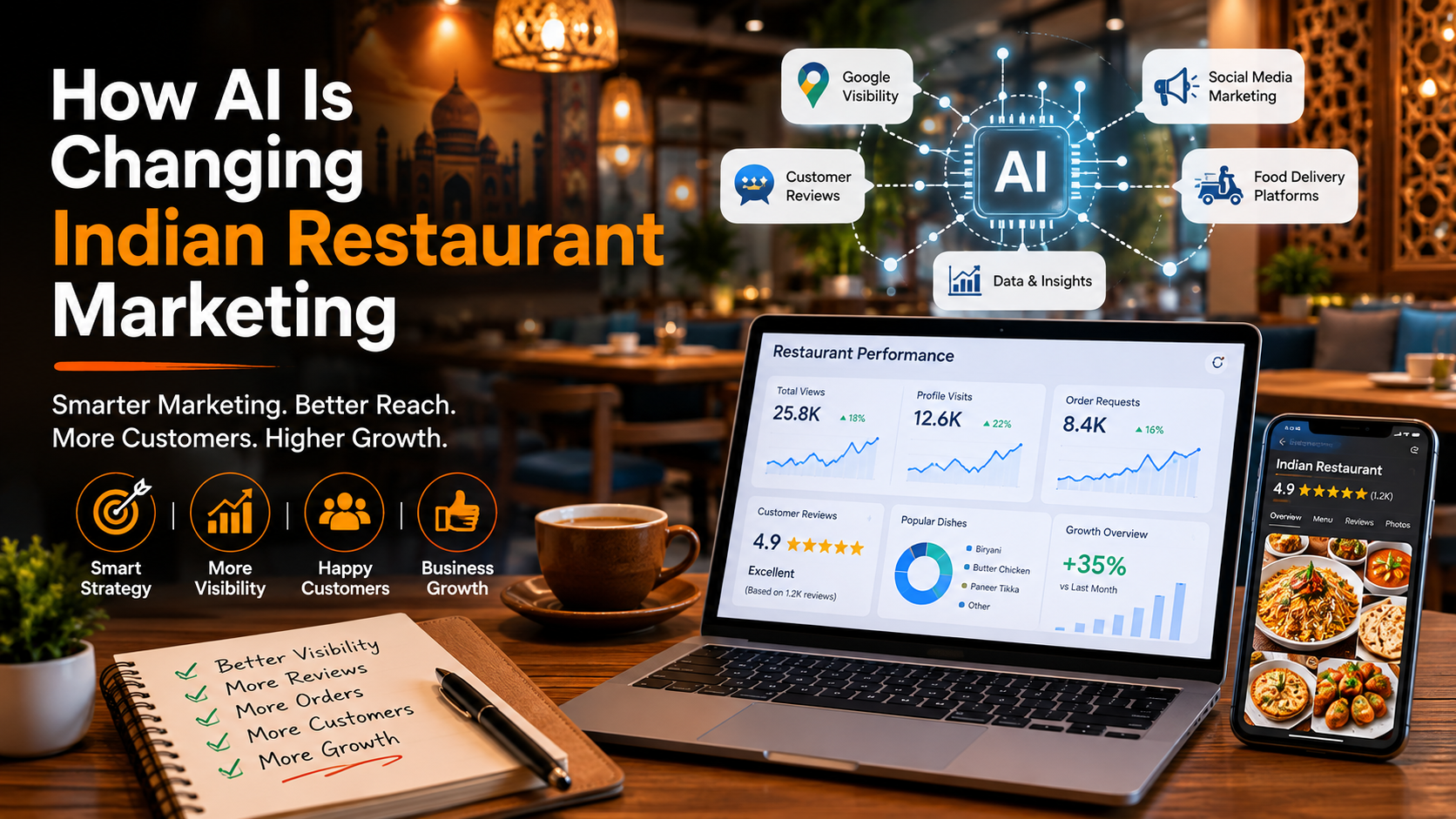
How AI Is Changing Indian Restaurant Marketing
Indian restaurant marketing is changing quickly.
For years, restaurant owners mainly depended on Google Search, Google Maps, Facebook, Instagram, food delivery apps, paid advertising, and word of mouth to attract customers.
Those channels are still important. But now there is another major change happening: Artificial Intelligence (AI) is becoming part of how customers search, compare, choose, and interact with restaurants.
People are no longer only typing simple searches such as “Indian restaurant near me.”
They are asking much more specific questions:
– “Where can I find authentic Indian food near my hotel?”
– “Which Indian restaurant nearby has good vegetarian options?”
– “Best halal Indian restaurant for a family dinner?”
– “Where can I get Jain food tonight?”
– “What Indian restaurant has good biryani and delivery?”
– “Recommend an Indian restaurant near me with good reviews.”
AI-powered search systems can understand these detailed questions much better than traditional keyword-based search.
For Indian restaurants, this creates both an opportunity and a challenge.
Restaurants with accurate information, strong reviews, useful websites, detailed menus, consistent business profiles, and clear descriptions are better positioned for this new era of restaurant discovery.
Here is how AI is changing Indian restaurant marketing — and what restaurant owners should be doing about it.
1. Restaurant Search Is Becoming More Conversational
Traditional search was heavily based on keywords.
A customer might search:
“Indian restaurant Hanoi”
or:
“Indian food near me.”
Today, customers can make much more conversational searches.
For example:
“I am travelling with my family and need an Indian restaurant with vegetarian food near my hotel.”
Or:
“Where can I find authentic North Indian food that is open late tonight?”
This changes restaurant SEO.
Restaurants should still target important keywords, but they also need to provide enough useful information for search engines and AI systems to understand exactly what the restaurant offers.
That means clearly communicating things such as:
– Cuisine type
– Vegetarian and vegan options
– Jain food availability
– Halal options
– Signature dishes
– Location
– Nearby landmarks
– Opening hours
– Delivery options
– Family-friendly dining
– Catering services
– Takeaway availability
The more clearly your restaurant is represented online, the easier it becomes for digital platforms to understand your business.
2. Google Business Profile Is Becoming Even More Important
For a local restaurant, your Google Business Profile is one of your most valuable digital assets.
It tells Google important information about your restaurant, including your location, category, opening hours, photos, menu, reviews and other business details.
But simply creating a profile is not enough.
Restaurant information should remain accurate and active.
Indian restaurants should regularly review their:
– Primary and secondary business categories
– Business description
– Opening hours
– Menu information
– Photos
– Attributes
– Website link
– Phone number
– Customer reviews
If your restaurant has special offerings such as Pure Vegetarian, Jain, Vegan or Halal food, make this information clear wherever appropriate.
Imagine two restaurants.
One profile simply says:
“Indian Restaurant.”
Another clearly communicates:
“Indian restaurant serving North Indian cuisine, vegetarian dishes, biryani, tandoori dishes, Jain options and takeaway.”
The second business provides far more context about what customers can expect.
That context becomes increasingly valuable as search becomes more intelligent.
3. Customer Reviews Are Becoming Valuable Restaurant Data
Reviews have always mattered.
They build trust, improve reputation and help potential customers decide where to eat.
But in an AI-driven search environment, the content inside reviews can also provide useful context about a restaurant.
Suppose customers repeatedly mention:
“Excellent butter chicken.”
“Very good vegetarian food.”
“Friendly staff.”
“Authentic Indian taste.”
“Great biryani.”
“Good place for families.”
“Helpful service for Jain food.”
Those reviews collectively describe what customers associate with the restaurant.
This is why restaurants should not focus only on the total number of reviews.
The quality, authenticity and detail of customer feedback matter too.
Restaurants should encourage genuine customers to describe their actual experiences rather than pushing everyone to leave identical or artificial comments.
A natural detailed review can help future customers understand the restaurant much better than a simple:
“Good food.”
4. AI Can Help Restaurants Respond to Reviews Better
Restaurant owners receive reviews from customers speaking many different languages.
This is particularly common for Indian restaurants operating in international tourist destinations.
Customers may write reviews in English, Vietnamese, Thai, Korean, Japanese, Arabic, French, Russian or other languages.
AI can help restaurants understand these reviews and prepare appropriate responses quickly.
However, restaurant owners should avoid turning review replies into robotic templates.
A customer who writes:
“The chicken biryani was fantastic and the staff helped us choose the spice level.”
should receive a response that acknowledges those specific details.
Personalised responses show customers that the restaurant actually values their feedback.
AI should help the restaurant communicate better — not remove the human element from hospitality.
5. Restaurant Websites Need to Answer Real Customer Questions
A restaurant website should no longer exist simply because every business is expected to have one.
It should answer the questions customers are actually asking.
For example:
Do you have vegetarian food?
Do you serve Jain food?
Is your restaurant halal?
Do you offer home delivery?
Which Indian dishes should first-time customers try?
Can you handle group bookings?
Do you provide catering?
How far are you from a popular tourist attraction?
Creating useful pages and blog content around genuine customer questions can strengthen the restaurant’s overall online presence.
This is especially valuable for restaurants in competitive tourist destinations where customers research their dining options before arriving.
6. Menus Are Becoming Marketing Content
Many restaurant owners still treat the menu as nothing more than a list of dishes and prices.
Online, a menu can do much more.
Compare these two listings:
Chicken Tikka Masala
versus
Chicken Tikka Masala – tender pieces of grilled chicken cooked in a rich, mildly spiced tomato and creamy gravy.
The second description gives customers — and digital systems — much more information about the dish.
Good menu descriptions can help customers understand unfamiliar Indian dishes and make ordering easier.
This is especially important when marketing Indian food to international customers who may not know the difference between dishes such as:
– Kadai Chicken
– Rogan Josh
– Dal Makhani
– Palak Paneer
– Chole
– Chicken Chettinad
– Paneer Tikka
– Hyderabadi Biryani
Instead of assuming customers already understand Indian cuisine, restaurants can use their menu descriptions to educate and attract them.
7. AI Is Making Multilingual Marketing Easier
Language has traditionally been a major marketing challenge for Indian restaurants operating outside India.
A restaurant in Vietnam may serve Indian travellers, Vietnamese residents, Korean tourists, Japanese tourists, Middle Eastern travellers, Europeans and customers from many other countries.
Creating content for different audiences used to require significant time and translation costs.
AI can now help restaurants create and adapt:
– Menu descriptions
– Social media posts
– Website content
– Customer review responses
– Promotional messages
– Frequently asked questions
into multiple languages much faster.
However, direct machine translation is not always enough.
Restaurant terminology, dish names, spice descriptions and cultural context still need human checking.
The goal should be localisation, not simply translation.
8. Social Media Content Can Be Produced Faster
One of the biggest problems restaurant owners face is consistency.
They may post regularly for one week and then disappear for a month.
AI tools can help restaurants plan and create content around:
– New dishes
– Chef recommendations
– Customer favourites
– Festivals
– Indian celebrations
– Local events
– Behind-the-scenes moments
– Vegetarian dishes
– Halal options
– Special menus
– Catering
– Customer testimonials
But restaurants should be careful.
Posting large amounts of generic AI-generated content will not automatically create engagement.
Customers still want to see the real restaurant.
Real food.
Real chefs.
Real customers.
Real atmosphere.
Real stories.
AI should make content creation easier while the restaurant itself remains the personality behind the content.
9. Food Delivery Marketing Is Becoming More Data-Driven
Food delivery platforms have become major customer acquisition channels for Indian restaurants in many countries.
Customers make fast decisions based on factors such as:
– Food photos
– Dish names
– Descriptions
– Ratings
– Reviews
– Promotions
– Delivery time
– Pricing
– Best sellers
– Restaurant reputation
AI can help restaurant marketers analyse menu structures and identify opportunities.
For example, restaurants can study which dishes should appear first, which products should be combined into meal deals, which menu descriptions need improvement, and which categories may be confusing customers.
Instead of uploading 100 dishes without strategy, restaurants can organise the menu around customer behaviour.
A strong digital menu should make ordering easy.
10. AI Can Help Restaurants Understand Their Customers
Restaurant marketing produces large amounts of information.
Google reviews.
Delivery reviews.
Social media comments.
Search queries.
Website traffic.
Popular menu items.
Customer questions.
Competitor activity.
Most small restaurant owners do not have time to manually analyse all of this information.
AI can help identify patterns.
For example, a restaurant may discover that customers frequently praise its biryani but rarely mention its other dishes.
Another restaurant may notice that customers repeatedly ask whether Jain food is available.
A third restaurant may discover that tourists frequently search for Indian food near a particular hotel or tourist attraction.
These insights can influence future marketing decisions.
The real value of AI is not simply generating content faster.
It is helping restaurants make better decisions from the information they already have.
11. AI Search Does Not Mean Traditional SEO Is Dead
There is a common misconception that AI will replace SEO completely.
That is unlikely to be the right way to think about it.
Search is evolving.
A restaurant still needs strong digital foundations:
Google Business Profile + Reviews + Website + Local SEO + Menu + Social Proof + Consistent Business Information
AI adds another layer to this ecosystem.
Instead of trying to find a secret “AI ranking trick,” restaurant owners should focus on making their business easy to understand online.
Clearly explain:
Who you are.
What you serve.
Where you are.
Who your restaurant is suitable for.
Why customers choose you.
What makes you different.
That information can benefit both traditional search and AI-powered discovery.
12. Restaurants Should Not Use AI to Fake Their Reputation
AI is powerful, but it can also be misused.
Restaurants should avoid using AI to create fake customer reviews, false testimonials, misleading food images or exaggerated claims.
Trust is extremely important in restaurant marketing.
Customers eventually experience the real restaurant.
If online marketing creates expectations that the restaurant cannot deliver, technology will not solve the problem.
The strongest marketing still starts with:
Good food.
Good service.
Cleanliness.
Hospitality.
Consistency.
AI can amplify a strong restaurant, but it cannot permanently hide a poor customer experience.
13. The Future: From “Search for a Restaurant” to “Ask for a Restaurant”
This may be one of the biggest changes ahead.
Customers traditionally opened a search engine and looked through many restaurant listings.
Increasingly, they can simply ask an AI assistant:
“Find me a good Indian restaurant nearby for dinner.”
Then they may add:
“It should have vegetarian options, good reviews and be open after 10 PM.”
Instead of browsing dozens of businesses, customers may receive a smaller set of recommendations.
That means restaurants need to think beyond ranking for one keyword.
They need to build a strong and consistent digital identity across the internet.
Your restaurant’s website, Google Business Profile, menu, customer reviews, local listings and other trusted online information should collectively tell the same story.
How Indian Restaurants Can Prepare for AI-Driven Marketing
Restaurant owners do not need to become AI experts.
Start with the fundamentals:
– Keep your Google Business Profile complete and accurate.
– Build a simple, fast and useful restaurant website.
– Publish detailed menu information.
– Encourage genuine customer reviews.
– Respond professionally to reviews.
– Clearly communicate vegetarian, vegan, Jain or halal options when available.
– Create useful content answering real customer questions.
– Keep your restaurant’s name, address, phone number and other important information consistent online.
– Improve your food delivery menu, photos and descriptions.
– Use AI to support your marketing team rather than completely replacing human judgement.
Final Thoughts
AI is not replacing restaurant marketing.
It is changing how restaurant marketing works.
Customers are becoming more conversational in the way they search. Search platforms are becoming better at understanding context. Reviews, menus, websites, local business information and customer experiences are becoming increasingly connected.
For Indian restaurants, this creates a major opportunity.
Restaurants that build a strong digital presence today will be better prepared for a future where customers may discover their next meal through Google, Maps, social media, delivery apps or an AI assistant.
The goal is not to chase every new AI tool.
The goal is to make your restaurant easy to find, easy to understand and easy to trust wherever customers are searching.
At HmmmBMA, we focus exclusively on marketing for Indian restaurants outside India. Our approach combines Google Business Profile optimisation, Local SEO, review strategy, website content, delivery-platform optimisation and AI-search visibility to help Indian restaurants build a stronger digital presence.
Because the future of restaurant marketing is not simply about being online.
It is about being understood, trusted and recommended.
