


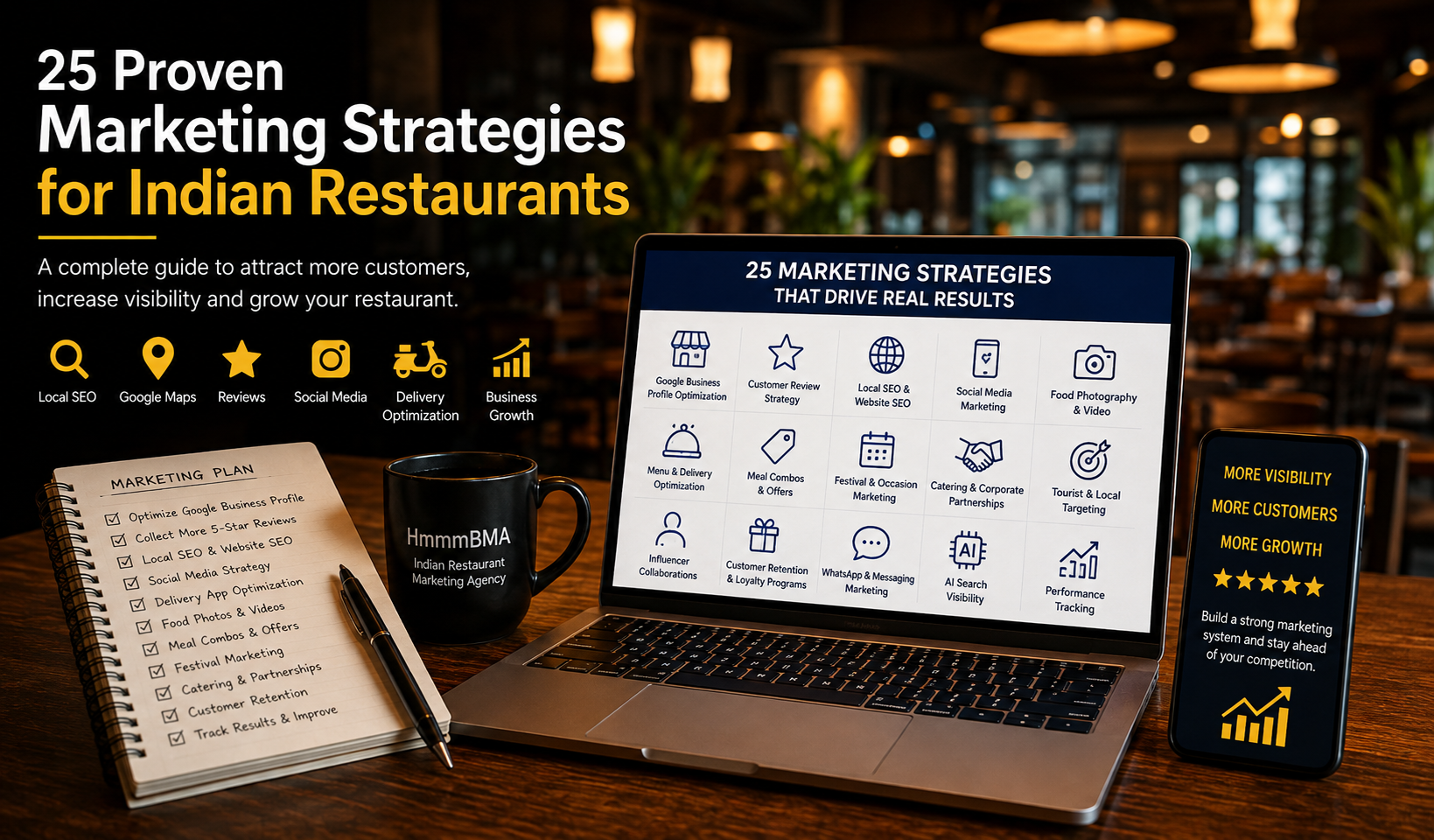
25 Proven Marketing Strategies for Indian Restaurants
Running a successful Indian restaurant today requires much more than serving delicious food.
Your butter chicken may be excellent. Your biryani may be authentic. Your chef may have years of experience. But if customers cannot discover your restaurant online, trust your reputation, understand your menu, or easily place an order, you may still lose business to competitors.
Modern restaurant customers discover places through Google Maps, Google Search, social media, food delivery apps, online reviews, websites, recommendations and increasingly AI-powered search tools.
For Indian restaurants, marketing also comes with unique opportunities. Indian cuisine has strong identities around dishes, regions, dietary preferences and dining occasions. Customers may search specifically for halal Indian food, vegetarian restaurants, Jain food, South Indian food, biryani, curry, tandoori dishes or Indian restaurants near a particular hotel or attraction.
The goal is not simply to advertise more.
The goal is to make your restaurant easy to find, easy to trust and easy to choose.
Here are 25 proven marketing strategies for Indian restaurants that can help increase visibility, attract new customers and build long-term growth.
1. Fully Optimize Your Google Business Profile
Your Google Business Profile should be one of your highest marketing priorities.
When someone searches:
– Indian restaurant near me
– Best Indian restaurant in City
– Indian food near me
– Halal Indian restaurant
– Vegetarian Indian restaurant
– Biryani near me
Google may show local restaurant results before customers even visit a website.
Make sure your profile contains accurate:
– Restaurant name
– Primary and secondary categories
– Address
– Phone number
– Opening hours
– Website
– Menu
– Reservation or ordering links
– Restaurant attributes
– High-quality photos
Do not treat your Google Business Profile as something you set up once and forget. Keep it active and accurate.
2. Build a Consistent Google Review Strategy
Reviews are one of the strongest forms of social proof for a restaurant.
A restaurant with hundreds of recent, genuine reviews can immediately appear more trustworthy than a competitor with very little customer feedback.
Train your team to politely ask satisfied customers to share their experience on Google.
Make the process simple by using:
– A Google review link
– QR codes
– Table cards
– Bill folders
– Takeaway inserts
– Follow-up messages where appropriate
Never buy fake reviews or offer rewards in exchange for positive reviews.
The objective should be to create a natural and consistent flow of genuine customer feedback.
3. Reply to Every Customer Review
Getting reviews is only half the job.
Responding to them shows future customers that the restaurant pays attention to its guests.
Avoid using the exact same response every time.
Where possible, personalize the reply using the customer’s name and something mentioned in their review.
For negative reviews, stay professional. Do not argue publicly. A thoughtful response can sometimes build more trust than the negative review removes.
Remember that your response is not only for the reviewer.
Future customers are reading it too.
4. Invest in Professional Food Photography
Customers eat with their eyes before they ever enter your restaurant.
Indian cuisine is particularly visual: colourful curries, biryani, naan, kebabs, dosas, thalis, chaat and tandoori dishes can perform extremely well when photographed correctly.
Use strong images across:
– Google Business Profile
– Website
– Food delivery apps
– Digital menus
– Advertisements
Your photos should represent the food customers will actually receive.
Good photography creates desire. Misleading photography creates disappointment.
5. Create a Local SEO Strategy
Restaurant SEO should focus heavily on local intent.
Instead of trying to rank for broad terms such as Indian food, target searches connected to the restaurant’s real location and offering.
Examples include:
– Indian restaurant in Tokyo
– Best Indian restaurant in Hanoi
– Indian food near My Khe Beach
– Halal Indian restaurant in Bangkok
– Vegetarian Indian restaurant in Singapore
– Indian restaurant near local landmark
Create useful website pages and content around the locations and services genuinely relevant to your restaurant.
Avoid keyword stuffing. Write naturally for real customers first.
6. Build a Fast, Mobile-Friendly Restaurant Website
Your restaurant should have an online property that it controls.
Social media platforms, delivery applications and third-party directories can change their rules at any time. Your website belongs to your business.
A good restaurant website should clearly display:
– Menu
– Address
– Opening hours
– Contact details
– Google Maps location
– Food photographs
– Dietary information
– Reservation options
– Delivery links
– About the restaurant
Most importantly, it must work well on mobile devices.
A hungry customer should not need five minutes to find your menu.
7. Optimize Your Menu for Search and Customers
A menu is not just an operational document.
It is a marketing asset.
Use clear dish names and helpful descriptions.
For example, a customer unfamiliar with Indian cuisine may not understand what Murgh Makhani means, but:
Butter Chicken – Creamy Indian Tomato & Butter Chicken Curry
provides much more information.
Descriptions can explain ingredients, flavour, cooking style and dietary suitability without becoming excessively long.
This is particularly important for Indian restaurants operating outside India.
8. Optimize Food Delivery App Listings
Customers often want convenience rather than endless choices.
Create combinations such as:
Butter Chicken + Garlic Naan + Rice
or
Paneer Curry + Naan + Rice + Drink
You can also create:
– Lunch combos
– Dinner sets
– Couple meals
– Family meals
– Office lunch sets
– Vegetarian combos
– Biryani combos
Good combos simplify decision-making while giving restaurants an opportunity to increase order value.
9. Create Strategic Meal Combos
Customers often want convenience rather than endless choices.
Create combinations such as:
Butter Chicken + Garlic Naan + Rice
or
Paneer Curry + Naan + Rice + Drink
You can also create:
– Lunch combos
– Dinner sets
– Couple meals
– Family meals
– Office lunch sets
– Vegetarian combos
– Biryani combos
Good combos simplify decision-making while giving restaurants an opportunity to increase order value.
10. Use Instagram as a Visual Restaurant Showcase
Instagram can be highly effective for food businesses.
Instead of only posting promotional posters, show the actual restaurant experience.
Content can include:
– Fresh dishes
– Kitchen preparation
– Tandoor cooking
– Chef videos
– Customer experiences
– Restaurant atmosphere
– New menu items
– Festivals
– Behind-the-scenes moments
Short-form video is particularly useful because it can communicate food, atmosphere and personality quickly.
Your social media should make someone hungry enough to visit.
11. Build an Active Facebook Presence
Facebook remains useful for local restaurant marketing, especially through community pages and groups.
Post a mixture of:
– Food
– Restaurant updates
– Offers
– Events
– Festivals
– Customer feedback
– New dishes
– Behind-the-scenes content
– Blog content
Where group rules permit, participate in local communities rather than simply posting advertisements.
The goal is to become recognizable within your local market.
12. Use Short-Form Video Marketing
A 15–30 second video can sometimes communicate more than several photographs.
Record simple moments such as:
– Naan coming from the tandoor
– Biryani being opened
– Curry being prepared
– Kebabs sizzling
– Chai being poured
– A chef plating a dish
– A busy dinner service
You do not need expensive production for every video.
Authentic restaurant content can work extremely well.
13. Market Your Restaurant’s Special Dietary Strengths
Indian restaurants often have important advantages that customers actively search for.
If genuinely applicable, clearly communicate options such as:
– 100% Halal
– Pure Vegetarian
– Jain Food
– Vegan Options
– Gluten-Conscious Options
– No Onion No Garlic Options
Do not hide these details deep inside the menu.
Include relevant information naturally across your website, Google profile, social media and delivery listings.
These features can influence a customer’s restaurant decision immediately.
14. Target Tourists in Tourist Cities
If your restaurant operates in a destination with international visitors, tourists may be an important customer segment.
Think about what travellers search for:
– Indian restaurant near my hotel
– Indian food near airport
– Indian restaurant near beach
– Vegetarian food near tourist attraction
– Halal food near me
Build content around legitimate nearby landmarks, hotels, attractions and neighbourhoods.
Also make your restaurant information easy for international customers to understand.
15. Target the Local Community, Not Only Indians
One common mistake is marketing an Indian restaurant only to Indian customers.
Indian cuisine has a global audience.
Create content that helps first-time customers understand the food.
Explain dishes, spice levels and ingredients.
Instead of assuming everyone knows what Chole Bhature is, introduce it.
Instead of only saying Dosa, explain the experience.
Education removes uncertainty and can turn someone who has never tried Indian food into a regular customer.
16. Use Festival and Occasion Marketing
Indian restaurants have an enormous calendar of marketing opportunities.
Examples include:
– Diwali
– Holi
– Eid
– Christmas
– New Year
– Valentine’s Day
– Mother’s Day
– Father’s Day
– Independence Day
– Local national holidays
Create special menus, family meals, catering packages or restaurant experiences when appropriate.
Start promotion early rather than publishing one social post on the day of the event.
17. Develop Corporate and Office Catering
Do not rely entirely on individual diners.
Businesses, embassies, offices, schools, organizations and event planners can generate larger orders.
Create dedicated catering options for:
– Office lunches
– Meetings
– Corporate events
– Birthday parties
– Private events
– Embassy events
– Group dinners
Make catering information easy to find online.
One corporate relationship can generate repeated business throughout the year.
18. Partner With Hotels and Tourism Businesses
Indian restaurants in tourist destinations should build relationships with nearby businesses.
Potential partners include:
– Hotels
– Hostels
– Tour operators
– Travel agencies
– Taxi services
– Local guides
Do not approach partnerships only by asking for referrals.
Look for arrangements where both businesses provide genuine value to their customers.
19. Work With Relevant Local Food Creators
Influencer marketing can work, but follower count should not be your only criterion.
A local creator with a smaller but highly relevant audience may produce better results than a large general account.
Look at:
– Audience location
– Engagement quality
– Content quality
– Food relevance
– Audience demographics
Give creators a real restaurant experience and allow them to communicate authentically.
20. Build a Customer Retention Strategy
Acquiring a customer once is expensive.
Getting a satisfied customer to return is often easier.
Consider retention tools such as:
– Loyalty programs
– Birthday offers
– VIP customer lists
– Repeat-order incentives
– Exclusive menu previews
– Special event invitations
The objective is to transform occasional diners into regular guests.
21. Use WhatsApp or Messaging Marketing Carefully
Where messaging platforms are commonly used and customers have opted in, they can help restaurants communicate directly.
Messages might include:
- New dishes
- Festival menus
- Special events
- Catering information
- Limited promotions
But do not spam customers.
Direct messaging works best when the information is useful and customers actually want to receive it.
22. Create Useful Blog Content
Blogging gives restaurants an opportunity to answer questions customers are already searching for.
Possible topics include:
– Best Indian dishes for first-time customers
– Vegetarian Indian food guide
– What is a thali?
– Difference between naan and roti
– Indian food near major local attractions
– Guide to Indian biryani
– Understanding Indian spice levels
Useful content can support search visibility while educating potential customers.
Do not publish articles only to fill your website.
Every article should answer a real customer question.
23. Prepare Your Restaurant for AI Search
Restaurant discovery is expanding beyond traditional Google searches.
Customers can now ask AI assistants questions such as:
“Where can I find a good Indian restaurant near my hotel?”
or
“What is a good halal Indian restaurant for dinner in this area?”
Restaurants should maintain clear and consistent information across their online presence.
Make important information easy to understand:
– What cuisine do you serve?
– Where are you located?
– Are you halal?
– Do you have vegetarian or -vegan food?
– What dishes are you known for?
– What are your opening hours?
– Do you offer delivery?
– Do you accept reservations?
AI visibility should complement your Google, website and local SEO strategy — not replace them.
24. Track Marketing Performance
Marketing without measurement becomes guesswork.
Track meaningful actions rather than only followers and likes.
Useful metrics can include:
– Google searches
– Website visits
– Direction requests
– Phone calls
– Menu views
– Reservations
– Delivery orders
– Average order value
– Review growth
– Returning customers
– Advertising cost
– Revenue generated from campaigns
Ask one simple question:
Is this marketing activity helping the restaurant generate more customers or stronger customer relationships?
If not, investigate why.
25. Build a Complete Marketing System
The most successful restaurant marketing does not depend on one platform.
Google Maps alone is not enough.
Instagram alone is not enough.
Paid advertising alone is not enough.
A stronger system connects:
Google Business Profile → Reviews → Local SEO → Website → Social Media → Delivery Apps → Customer Retention → AI Search Visibility
Each channel supports the others.
A customer may discover your restaurant on Google, read reviews, check Instagram, open your menu and finally visit or order.
Marketing should support that complete journey.
Final Thoughts
Indian restaurant marketing is not about being everywhere or spending the biggest advertising budget.
It is about being visible in the right places when potential customers are deciding where to eat, what to order and which restaurant to trust.
Start with the foundations:
Optimize Google Business Profile. Build genuine reviews. Improve your website. Strengthen local SEO. Upgrade your food photography. Optimize delivery platforms. Create useful social content.
Then add more advanced strategies such as customer retention, partnerships, catering, paid campaigns and AI search visibility.
Most importantly, stay consistent.
A single Instagram post will not transform a restaurant.
Ten reviews collected in one week and none for the next six months will not build a sustainable reputation.
One SEO update will not dominate local search forever.
Restaurant marketing is a continuous process.
The restaurants that build strong digital visibility, maintain excellent customer experiences and consistently communicate what makes them special put themselves in the strongest position for long-term growth.
How HmmmBMA Helps Indian Restaurants Grow
HmmmBMA is an Indian Restaurant Marketing Agency focused exclusively on helping Indian restaurants improve their online visibility and attract more customers.
Our approach focuses on the channels that matter most for restaurant discovery and growth, including:
– Google Business Profile Optimization
– Google Maps & Local SEO
– Review Management
– Restaurant Website SEO
– AI Search Visibility
– Social Media Marketing
– Food Delivery Platform Optimization
– Restaurant Marketing Strategy
Whether your Indian restaurant operates in Vietnam, Thailand, Japan, South Korea, Singapore, Malaysia, Indonesia, Australia, New Zealand, the United States or another international market, your marketing strategy should be adapted to your local customers and competition.
Great Indian food deserves to be discovered.
The right marketing strategy helps make that happen.
