


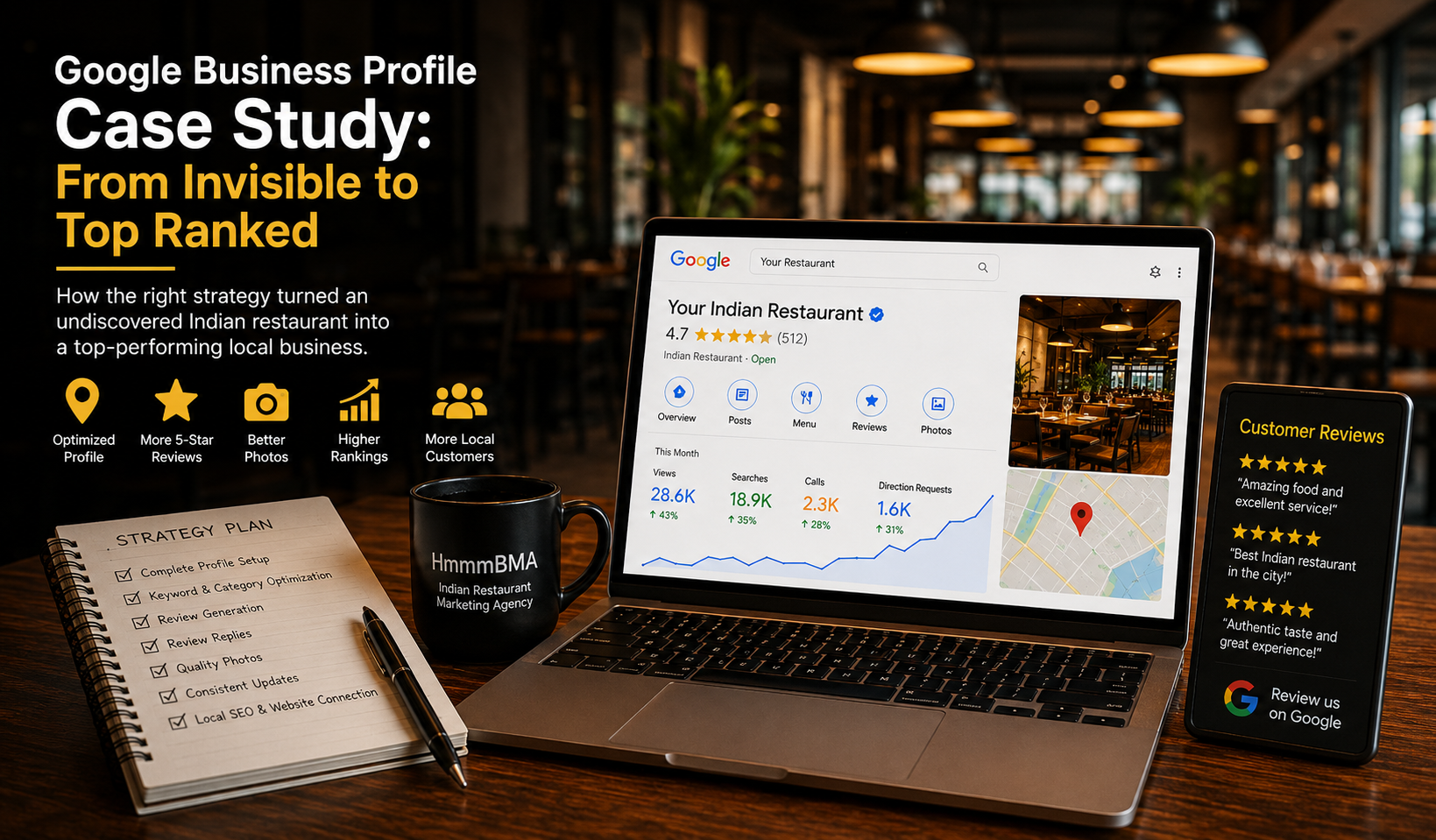
Google Business Profile Case Study: From Invisible to Top Ranked
Having great Indian food does not automatically mean customers will find your restaurant.
Today, when someone searches “Indian restaurant near me,” “best Indian restaurant,” “Indian food near me,” “halal Indian restaurant,” or “vegetarian Indian restaurant,” Google often becomes the first place where the customer makes a decision.
They look at the restaurants appearing on Google Maps, check photos, read recent reviews, compare ratings, look at the menu and then decide where to eat.
For one Indian restaurant, this was exactly the problem.
The restaurant served authentic Indian food and had satisfied customers, but its Google Business Profile was barely visible for important local searches.
This case study explains the strategy used to strengthen the restaurant’s Google presence and turn an underperforming profile into a much stronger local search asset.
The Problem: A Good Restaurant That Customers Couldn’t Find
The restaurant had many things going for it:
– Authentic Indian cuisine
– A good location
– Satisfied customers
– Vegetarian and non-vegetarian options
– Friendly service
– Delivery and takeaway availability
But online, the restaurant was struggling.
Its Google Business Profile had incomplete information, inconsistent activity, limited recent photos and too few fresh reviews.
More importantly, the profile did not clearly communicate to Google what the restaurant offered, where it was located and which customers it was relevant to.
That meant potential customers searching for Indian food nearby could easily discover competitors first.
Key Problem: The restaurant was good offline, but its Google presence did not properly represent the business online.
Step 1: Google Business Profile Optimization
The first step was not advertising.
It was fixing the foundation.
The restaurant’s Google Business Profile was reviewed and optimized with accurate, useful and consistent information.
We focused on elements such as:
– Correct restaurant name
– Primary and secondary business categories
– Opening hours
– Restaurant description
– Contact information
– Website connection
– Menu information
– Dining and service attributes
– Food and restaurant photos
– Relevant business information
The goal was not to stuff keywords everywhere.
Instead, the objective was to help Google and potential customers clearly understand the restaurant.
Key Strategy: Give Google complete and accurate information before expecting Google to rank the business.
Step 2: Targeting the Right Local Searches
The first step was not advertising.
It was fixing the foundation.
The restaurant’s Google Business Profile was reviewed and optimized with accurate, useful and consistent information.
We focused on elements such as:
– Correct restaurant name
– Primary and secondary business categories
– Opening hours
– Restaurant description
– Contact information
– Website connection
– Menu information
– Dining and service attributes
– Food and restaurant photos
– Relevant business information
The goal was not to stuff keywords everywhere.
Instead, the objective was to help Google and potential customers clearly understand the restaurant.
Key Strategy: Give Google complete and accurate information before expecting Google to rank the business.
Step 3: Building a Better Review Strategy
Reviews became one of the most important parts of the strategy.
The restaurant already had happy customers, but many of them simply left without writing a Google review.
A simple review-generation process was introduced.
Satisfied customers were politely encouraged to share their genuine experience on Google.
There were no fake reviews.
There were no purchased reviews.
There was no pressure on customers to leave only positive feedback.
The objective was simply to make it easier for real customers to share real experiences.
Over time, the profile began receiving more fresh and relevant customer feedback.
Reviews also naturally mentioned dishes, service and dining experiences.
For example, genuine customers might talk about:
– Butter chicken
– Biryani
– Naan
– Vegetarian dishes
– Halal food
– Staff service
– Restaurant atmosphere
– Family dining
– Authentic Indian taste
This information is valuable not only to Google but also to future customers reading the reviews.
Key Strategy: Consistent genuine reviews build trust, improve conversion and strengthen the overall Google Business Profile.
Step 4: Replying to Every Review Properly
Getting reviews was only half of the job.
The restaurant also needed to communicate with the customers who took the time to leave them.
Instead of repeatedly replying:
“Thank you for your review.”
Responses became more personal and relevant.
If a customer mentioned biryani, the reply acknowledged the biryani.
If someone complimented the staff, the response thanked them for recognizing the team.
If an international visitor shared their experience, the reply could acknowledge their visit appropriately.
Negative reviews were handled professionally rather than defensively.
Key Strategy: A review reply is not only for the reviewer. Future customers may read it before deciding whether to visit the restaurant.
Step 5: Improving Restaurant Photos
Food is visual.
Customers want to see what they are going to eat before they make a decision.
The restaurant’s profile therefore needed better visual content.
We focused on maintaining useful and attractive photos including:
– Signature Indian dishes
– Curries
– Biryani
– Naan and breads
– Starters
– Drinks
– Restaurant interior
– Exterior and entrance
– Dining environment
Instead of uploading everything at once and forgetting about the profile, new photos could be added consistently over time.
Key Strategy: Your Google Business Profile should visually represent the experience customers can expect when they visit.
Step 6: Keeping the Profile Active
One common mistake restaurant owners make is optimizing their Google Business Profile once and then ignoring it.
Local visibility requires ongoing attention.
The profile was kept updated with relevant business information, new photos, customer reviews and responses.
Important changes such as opening hours, menu information or services also needed to remain accurate.
This created a profile that looked active, maintained and trustworthy.
Key Strategy: Google Business Profile optimization is not a one-time job. It is an ongoing local marketing process.
Step 7: Connecting Google Business Profile With the Website
Google Business Profile should not operate completely separately from the restaurant’s website.
The website and profile should reinforce each other.
The restaurant website should clearly communicate:
– Restaurant name
– Location
– Cuisine
– Menu
– Opening hours
– Contact information
– Important services
– Relevant restaurant information
Location-specific website content can also help search engines better understand the restaurant’s relevance to its area.
Key Strategy: Your website, Google Business Profile and other online restaurant information should tell the same story.
What Changed?
After consistently improving the restaurant’s Google presence, the profile became significantly stronger for relevant local searches.
The biggest change was not simply a ranking position.
It was visibility.
More potential customers could discover the restaurant while actively searching for Indian food.
The restaurant developed a stronger profile through:
– Better Google Business Profile optimization
– More complete restaurant information
– Fresh customer reviews
– Professional review responses
– Better food photography
– Improved local relevance
– Consistent profile activity
– Stronger connection between Google and the restaurant website
The restaurant moved from being difficult to discover toward becoming a much stronger competitor in local Google and Maps searches.
Why Better Google Visibility Matters
Imagine two Indian restaurants serving similar food in the same area.
Restaurant A has:
– Few recent reviews
– Old photos
– Incomplete information
– Little profile activity
– No professional review responses
Restaurant B has:
– Fresh customer reviews
– Quality food photos
– Complete information
– Updated hours
– Relevant menu details
– Professional responses
– A well-maintained profile
Which restaurant is a new customer more likely to trust?
Usually, the second one.
Google visibility gets the restaurant discovered.
Trust turns that discovery into a customer.
Ranking is important, but visibility without trust does not automatically create sales.
Google Maps Is the New Restaurant Front Door
For many customers, the first interaction with your restaurant no longer happens at the physical entrance.
It happens on their phone.
They search.
They compare.
They read reviews.
They look at photos.
They check the menu.
They look at the location.
And then they decide.
This means your Google Business Profile has effectively become a digital front door for your restaurant.
If that front door looks incomplete, inactive or unreliable, customers can move to another restaurant within seconds.
What Indian Restaurant Owners Can Learn From This Case Study
The biggest lesson is simple:
You do not need to change your food to improve your Google visibility. Sometimes you need to improve how effectively your restaurant is represented online.
A strong Google Business Profile strategy should focus on:
– Complete and accurate information
– Relevant local search visibility
– Genuine customer reviews
– Professional review management
– High-quality restaurant and food photos
– Consistent profile activity
– Website and local SEO support
– A better customer journey from search to reservation, call, directions or order
None of these strategies should involve manipulating Google rankings.
The objective is to create a useful, accurate and trustworthy restaurant presence that deserves to be discovered.
From Google Ranking to Real Customers
Getting into stronger Google Maps positions is valuable, but rankings should never be the final goal.
The real goal is what happens after someone discovers the restaurant.
Can they quickly understand what food you serve?
Do your reviews make them trust you?
Do your photos make the food appealing?
Can they easily find directions?
Can they call you?
Can they see your menu?
Can they order food?
Can they make a reservation?
Successful local restaurant marketing connects Google visibility with real customer actions.
That is where Google Business Profile optimization becomes much more than SEO.
It becomes part of the restaurant’s customer acquisition system.
Final Thoughts
An Indian restaurant can serve excellent food and still remain almost invisible online.
At the same time, competitors with stronger digital visibility can capture customers simply because they are easier to discover and trust.
This case study demonstrates why Google Business Profile optimization, review management, local SEO, photos, accurate restaurant information and consistent activity should work together.
There is no single trick that takes a restaurant from invisible to highly visible overnight.
Sustainable results come from doing the fundamentals properly and consistently.
The goal is not simply to rank higher. The goal is to make sure that when someone nearby is searching for Indian food, your restaurant has the strongest possible opportunity to be discovered, trusted and chosen.
Need Help Growing Your Indian Restaurant on Google?
At HmmmBMA, we focus exclusively on marketing for Indian restaurants.
We help Indian restaurants strengthen their presence through Google Business Profile optimization, local SEO, review strategy, website SEO, social media and AI search visibility.
Whether your restaurant is in Vietnam, Thailand, South Korea, Japan, Singapore, Malaysia, Indonesia, Australia, the United States or anywhere else, the objective remains the same:
Help more customers discover your Indian restaurant when they are actively searching for Indian food.
Your food may already be excellent. Now make sure people can find it.
HmmmBMA – Indian Restaurant Marketing Agency
