


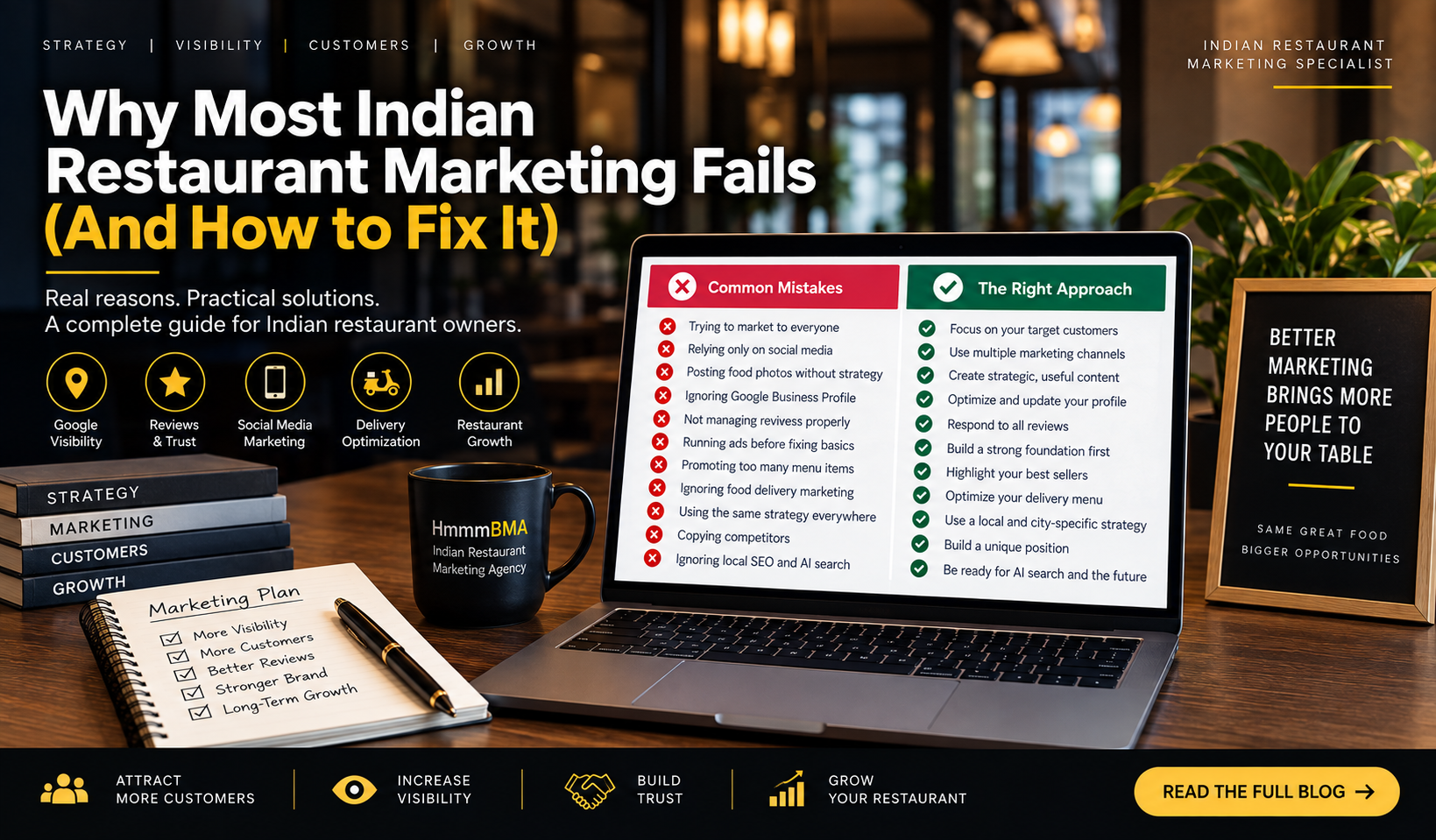
Why Most Indian Restaurant Marketing Fails (And How to Fix It)
Indian restaurants are everywhere today—from Hanoi, Ho Chi Minh City and Bangkok to Tokyo, London, Dubai, New York and beyond.
Yet many restaurant owners face the same problem:
They serve good food, customers enjoy the experience, and people leave positive feedback—but the restaurant still struggles to attract enough new customers consistently.
The problem is often not the food.
The problem is the marketing strategy.
Many Indian restaurants are doing marketing, but they are doing individual marketing activities without connecting them into one complete system.
Posting on Facebook, uploading a food photo, running an advertisement or collecting Google reviews can help. But when these activities are not connected, the restaurant may spend time and money without seeing meaningful growth.
Here are some of the biggest reasons Indian restaurant marketing fails—and how restaurant owners can fix them.
Trying to Market to Everyone
One of the biggest mistakes restaurants make is trying to attract everybody.
An Indian restaurant may offer:
– North Indian food
– South Indian food
– Halal food
– Pure vegetarian food
– Jain food
– Vegan dishes
– Gujarati food
– Punjabi food
– Biryani
– Tandoori dishes
– Indo-Chinese food
But who is the restaurant’s main customer?
Indian families?
Local Vietnamese customers?
Muslim travelers?
Vegetarians?
Office workers?
Tourists?
Students?
Indian expatriates?
A restaurant cannot communicate effectively if it does not understand who it is trying to reach.
How to Fix It
Identify your major customer groups and create marketing around them.
For example, a Halal Indian restaurant near a tourist area can create content for Muslim travelers searching for Halal food.
A pure vegetarian Indian restaurant can focus more heavily on vegetarian, Jain and vegan customers.
A restaurant near offices can promote lunch combinations during weekdays.
Your food may appeal to many people, but your marketing message should speak clearly to specific customers.
Depending Only on Facebook and Instagram
Facebook and Instagram are useful, but they should not be your entire marketing strategy.
Someone scrolling through Instagram might discover your restaurant.
But someone searching:
“Indian restaurant near me”
“Best Indian food in Hanoi”
“Halal Indian restaurant near me”
“Pure vegetarian restaurant near me”
is already looking for somewhere to eat.
That customer has much stronger buying intent.
If your restaurant is active on social media but difficult to discover through Google, Google Maps, AI search or local searches, you may be missing valuable customers every day.
How to Fix It
Build your restaurant’s presence across multiple discovery channels:
– Google Business Profile
– Google Maps
– Restaurant website
– Local SEO
– TikTok
– YouTube
– Food delivery platforms
– Travel and restaurant platforms
– Relevant local directories
– AI search platforms
Think about where customers search before they decide where to eat.
Your restaurant should appear in as many relevant places as possible.
Posting Food Photos Without a Strategy
A beautiful Butter Chicken photo can get likes.
But likes do not automatically become restaurant customers.
Many restaurants post:
“Delicious Butter Chicken available today!”
Then upload another dish the next day.
And another one after that.
There is nothing wrong with food photography, but every piece of content should have a purpose.
How to Fix It
Create different types of restaurant content.
For example:
Food Discovery Content
Introduce signature dishes such as Butter Chicken, Chicken Biryani, Paneer Butter Masala or Masala Dosa.
Customer Experience Content
Show families, travelers, celebrations and genuine restaurant moments.
Educational Content
Explain questions such as:
“What is Dal Makhani?”
“What is the difference between Chicken Tikka and Chicken Tikka Masala?”
“Which Indian dishes are good for someone trying Indian food for the first time?”
Location Content
Help people understand where your restaurant is located and which landmarks are nearby.
Dietary Content
Explain whether you provide Halal, vegetarian, vegan or Jain options when applicable.
Trust Content
Share genuine customer feedback, restaurant atmosphere, kitchen standards and team stories.
The objective is not simply to fill your social media page.
The objective is to help customers discover, understand and trust your restaurant.
Ignoring Google Business Profile
For local restaurants, Google Business Profile can be one of the most important digital assets.
Customers often check Google before choosing a restaurant.
They may look at:
– Rating
– Reviews
– Food photos
– Menu
– Location
– Opening hours
– Phone number
– Directions
– Popular dishes
– Recent activity
Yet many restaurants create their Google profile once and rarely update it.
Old photos remain.
Menus become outdated.
Opening hours are incorrect.
Reviews go unanswered.
Restaurant categories may not be properly configured.
This can hurt customer confidence and local visibility.
How to Fix It
Treat your Google Business Profile like a second restaurant entrance.
Keep it updated.
Regularly review:
– Restaurant name
– Primary and additional categories
– Address
– Opening hours
– Phone information
– Website
– Menu
– Services
– Food photos
– Interior and exterior photos
– Customer reviews
– Review responses
– Business description
– Relevant attributes
Google should immediately understand what your restaurant offers, where it is located and which customers it may be relevant to.
Collecting Reviews but Ignoring Review Management
Getting reviews is important.
But simply increasing the number of reviews is not enough.
Future customers read them.
They also read how the restaurant responds.
A thoughtful response can show that the restaurant listens to customers and cares about their experience.
A defensive or copy-pasted response can do the opposite.
How to Fix It
Respond naturally to reviews.
Thank happy customers.
Acknowledge the dish or experience they mentioned.
For negative reviews, avoid arguments.
Understand the complaint, respond professionally and explain how the restaurant will improve where appropriate.
Remember that your reply is not only for the person who wrote the review.
Hundreds of future customers may read it before deciding whether to visit your restaurant.
Running Ads Before Fixing the Basics
Another common mistake is spending money on Facebook, Instagram or other advertisements before the restaurant’s online presence is ready.
An advertisement might bring someone to your profile.
But what happens next?
The customer sees outdated photos.
They cannot find the menu.
The Google profile has unanswered reviews.
The restaurant address is unclear.
Social media has not been updated for months.
The customer leaves.
Advertising cannot permanently fix a weak online presence.
It simply sends more people toward it.
How to Fix It
Before increasing advertising, make sure the restaurant has:
– Strong Google presence
– Updated menu
– Professional food photos
– Clear location information
– Good review management
– Active social media
– Easy contact options
– Attractive bestselling dishes
– Clear restaurant positioning
Then advertising can amplify something that already works.
Promoting the Entire Menu Instead of Best Sellers
Some restaurants have 100, 150 or even 200 menu items.
Trying to advertise everything creates confusion.
Customers usually need a few strong reasons to choose your restaurant.
How to Fix It
Identify your hero products.
These could include:
– Butter Chicken
– Chicken Tikka Masala
– Chicken Biryani
– Mutton Biryani
– Dal Makhani
– Paneer Butter Masala
– Masala Dosa
– Garlic Naan
– Tandoori Chicken
– Mango Lassi
Your exact list depends on your restaurant.
Promote your strongest dishes repeatedly.
Create a Best Sellers section on delivery platforms when possible.
Use these dishes in ads.
Feature them on your website.
Photograph them professionally.
Include them naturally in social content.
Customers remember restaurants for particular dishes.
Give them something to remember.
Ignoring Food Delivery Marketing
Many restaurants treat GrabFood, ShopeeFood and other delivery platforms simply as online menus.
But delivery platforms are search engines too.
Customers compare restaurants, dishes, prices, discounts, photos and ratings before ordering.
Poor menu organization can reduce conversion even when the food itself is excellent.
How to Fix It
Optimize your delivery menu.
Use clear categories such as:
– Best Sellers
– Value Combos
– Vegetarian Starters
– Non-Vegetarian Starters
– Chicken Curries
– Vegetarian Curries
– Biryani & Rice
– Naan & Breads
– Desserts
– Drinks
Use professional food photos.
Create attractive combinations.
Keep descriptions easy to understand.
Highlight dishes that perform well.
A customer should be able to understand your menu quickly from a mobile phone.
Using the Same Marketing in Every City
Indian restaurant customers behave differently depending on location.
Marketing that works in Hanoi may not work exactly the same way in Pattaya.
Marketing for tourists in Da Nang may be different from marketing for office workers in Ho Chi Minh City.
Marketing in Tokyo will differ again.
How to Fix It
Build marketing around the local market.
Research:
– Customer demographics
– Tourist areas
– Nearby hotels
– Offices
– Universities
– Indian communities
– Muslim communities
– Vegetarian communities
– Local food habits
– Competitors
– Delivery demand
– Popular search terms
– Price expectations
Your restaurant marketing should be local.
Not copied from another restaurant in another city.
Copying Competitors Instead of Building a Position
If every Indian restaurant says:
“Authentic Indian Food”
“Best Indian Restaurant”
“Delicious Indian Cuisine”
customers have very little reason to remember one restaurant over another.
How to Fix It
Develop a clearer position.
For example:
A restaurant could become known for:
– Premium North Indian dining
– Affordable Indian comfort food
– Authentic South Indian cuisine
– Halal Indian food
– Pure vegetarian and Jain dining
– Late-night Indian food
– Indian family dining
– Outstanding biryani
– Office lunch combinations
– Indian street food
You do not necessarily need to change your menu.
You need to make it easier for customers to understand what makes your restaurant worth choosing.
Ignoring Local SEO
Having a website is not the same as having a website that attracts customers.
A restaurant website should answer the questions people are searching for.
For example:
“Where can I find Indian food in Hanoi?”
“Is there a Halal Indian restaurant near my hotel?”
“Where can I find vegetarian Indian food?”
“What Indian dishes should I try?”
“Where can I order Indian food delivery?”
How to Fix It
Create useful website content around genuine customer questions.
This may include:
– City-specific restaurant pages
– Neighborhood guides
– Dish guides
– Vegetarian dining guides
– Halal dining information
– Indian food guides
– Tourist dining guides
– Delivery information
– Restaurant FAQs
– Blog articles
This content can help search engines and AI platforms understand your restaurant better.
More importantly, it helps real customers.
Forgetting About AI Search
Restaurant discovery is changing.
People no longer search only through traditional search engines.
Customers increasingly ask AI assistants questions such as:
“Where can I eat Indian food near my hotel?”
“Which Indian restaurant has vegetarian options?”
“Where can I get Butter Chicken in Hanoi?”
“Which Indian restaurant is good for a family dinner?”
AI systems need clear and consistent information to understand businesses.
How to Fix It
Make sure information about your restaurant is consistent across:
– Website
– Google Business Profile
– Social platforms
– Delivery platforms
– Review platforms
– Local business listings
Create natural content answering common customer questions.
Clearly explain your cuisine, location, popular dishes, dietary options, opening hours and services.
Do not write content only for algorithms.
Write for customers first.
Clear information is also easier for search engines and AI systems to understand.
The Biggest Marketing Problem: No Complete System
This is where most restaurant marketing goes wrong.
The restaurant has:
Facebook.
Instagram.
Google.
A website.
Delivery apps.
Maybe TikTok.
Maybe advertisements.
But everything operates separately.
Successful restaurant marketing connects these channels.
A customer might:
See your restaurant on TikTok.
Search your name on Google.
Read your reviews.
Look at your food photos.
Visit your website.
Check your menu.
Then place an order through a delivery app.
Or visit the restaurant.
That entire journey matters.
Marketing should help move the customer from:
Discovery → Interest → Trust → Decision → Order → Review → Return Visit
That is a marketing system.
A Better Indian Restaurant Marketing Strategy
Instead of doing random marketing activities, focus on five areas.
1. Visibility
Make sure people can discover the restaurant through Google, Maps, social media, delivery platforms and local search.
2. Relevance
Clearly communicate what you serve and which customers your restaurant is best suited for.
3. Trust
Build confidence through genuine reviews, professional photos, accurate information and customer experiences.
4. Conversion
Make it easy for customers to view the menu, call, message, order delivery, get directions or reserve a table.
5. Retention
Give customers reasons to return through good service, consistent food, new offers and ongoing communication.
When these five areas work together, restaurant marketing becomes much more powerful.
Marketing Cannot Fix Everything
Marketing can bring people through the door.
But marketing cannot compensate forever for:
– Poor food quality
– Bad customer service
– Incorrect orders
– Long waiting times
– Dirty dining areas
– Inconsistent portions
– Unreasonable pricing
– Poor delivery packaging
Marketing brings attention.
Operations determine what customers say afterward.
The strongest restaurants combine good marketing with a good customer experience.
Final Thoughts
Most Indian restaurants do not fail at marketing because they are doing absolutely nothing.
They fail because they are doing many disconnected things.
A Facebook post here.
An Instagram Reel there.
A discount next week.
A Google review occasionally.
An advertisement when sales become slow.
Effective restaurant marketing requires consistency and connection.
Your Google presence should support your social media.
Your website should support Google search.
Your reviews should build trust.
Your delivery menu should help convert customers.
Your content should explain your restaurant.
Your advertisements should amplify what already works.
When all these pieces work together, marketing stops being random promotion and becomes a customer acquisition system.
Frequently Asked Questions About Indian Restaurant Marketing
What is the best marketing strategy for an Indian restaurant?
There is no single best channel. A strong strategy normally combines Google Business Profile optimization, local SEO, review management, social media, professional food content, delivery-platform optimization and targeted advertising.
Is social media enough to market an Indian restaurant?
No. Social media can create awareness, but restaurants should also focus on Google Maps, local search, reviews, websites, delivery platforms and other places customers use when deciding where to eat.
How can an Indian restaurant attract more local customers?
Start by understanding the local customer base, optimizing Google Business Profile, creating location-relevant content, collecting genuine reviews and promoting dishes that appeal to the local market.
Should Indian restaurants invest in Google or Facebook marketing?
Both can be useful for different reasons. Google is particularly powerful when someone is already searching for a restaurant, while Facebook and Instagram can help create awareness and reach specific audiences.
How important are Google reviews for an Indian restaurant?
Very important. Customers often compare ratings, recent reviews, food photos and restaurant responses before choosing where to eat. Reviews influence both trust and the customer’s final decision.
Can AI search help customers discover restaurants?
Yes. Customers increasingly use AI tools to ask restaurant-related questions. Maintaining clear, accurate and consistent restaurant information across your website and other major platforms can improve the chances that AI systems understand your business correctly.
Need a Better Marketing Strategy for Your Indian Restaurant?
HmmmBMA focuses on marketing for Indian restaurants.
We help restaurants improve their online presence across areas such as:
Google Business Profile & Google Maps
Google Review Management
Website & Local SEO
AI Search Visibility
Facebook & Instagram Marketing
TikTok & YouTube Content
Food Delivery Platform Optimization
Food & Menu Marketing
Competitor Research
Restaurant Growth Strategy
Every restaurant, city and customer market is different.
Instead of copying the same strategy for every restaurant, HmmmBMA builds marketing around the restaurant’s food, location, competition and target customers.
Visit HmmmBMA to learn more about Indian restaurant marketing strategies.
