


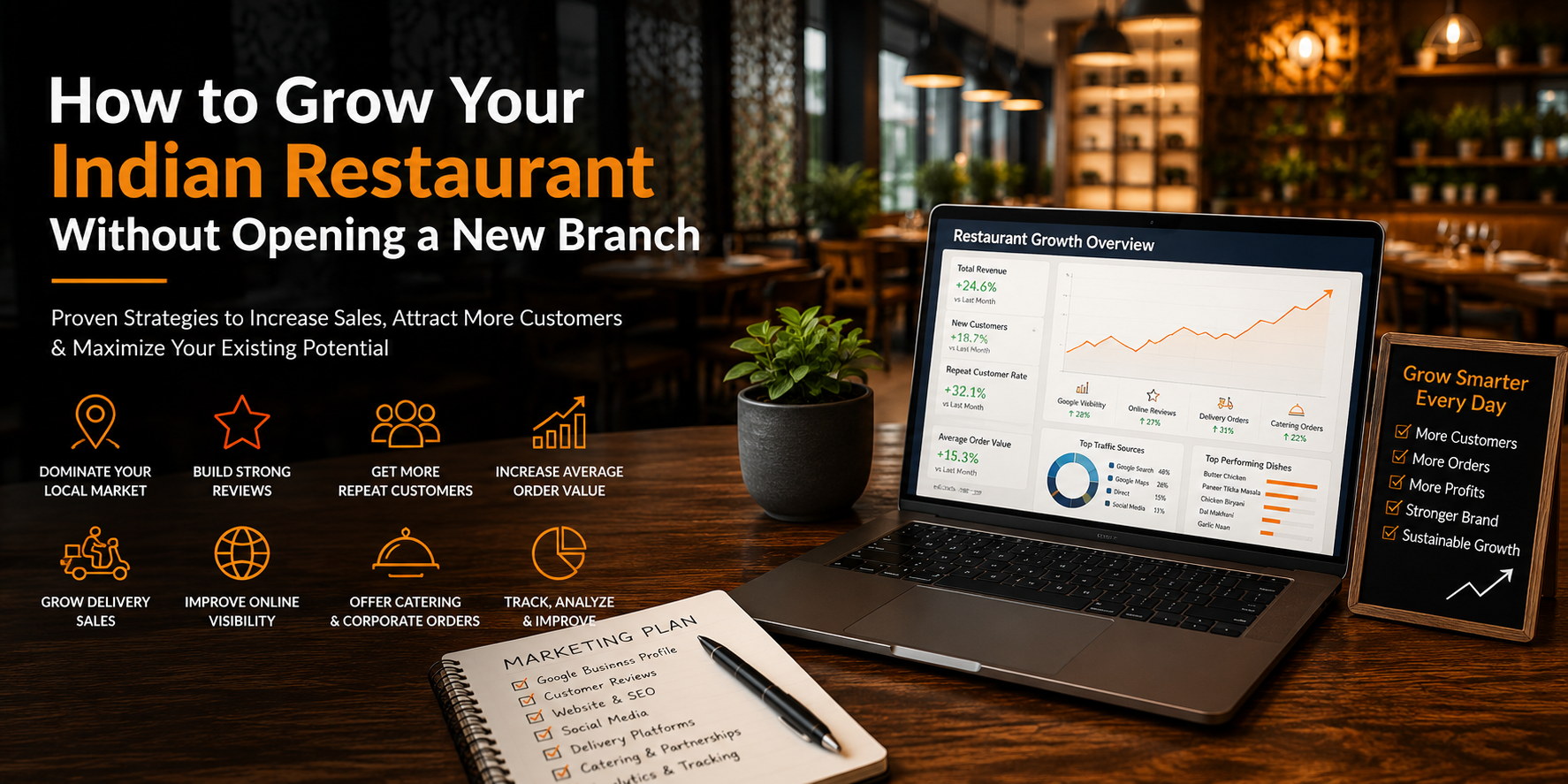
How to Grow Your Indian Restaurant Without Opening a New Branch
Opening another branch may look like the natural next step when an Indian restaurant wants to grow.
But a second location also means another rent agreement, another kitchen, more equipment, more employees, more inventory, more management and considerably more risk.
Before expanding geographically, there is a more important question:
Are you getting the maximum possible business from the restaurant you already have?
For many Indian restaurants, the answer is no.
There may still be significant opportunities to increase reservations, walk-ins, takeaway orders, delivery sales, repeat customers and average spending from the existing location.
This guide explains practical ways to grow an Indian restaurant without opening another branch.
Understand What Growth Actually Means
Restaurant growth does not necessarily mean having more locations.
A restaurant can grow substantially from a single branch by improving:
– Number of customers
– Table occupancy
– Average bill value
– Repeat visits
– Delivery orders
– Takeaway orders
– Direct orders
– Catering and group bookings
– Online visibility
– Customer retention
For example, if your restaurant serves 80 customers per day, increasing that to 100 customers is growth.
If the average bill rises from $20 to $24 without damaging customer satisfaction, that is growth too.
If customers who normally visit once every two months begin visiting monthly, you have grown again.
The objective should therefore be:
Make the existing restaurant more productive before making the business bigger physically.
Dominate Your Local Market First
Before thinking about another city—or even another neighbourhood—try to become one of the strongest Indian restaurant choices in your existing trade area.
Think about the people located within a realistic travelling distance of your restaurant.
Depending on the city, these may include:
– Local residents
– Indian expatriates
– International expatriates
– Tourists
– Hotel guests
– Office workers
– University students
– Families
– Vegetarian and vegan customers
– Halal diners
– Business travellers
Your restaurant does not need everybody in the city.
It needs a strong share of the customers who can realistically choose your restaurant.
Study the area around your restaurant
Look approximately 1–5 km around your location and identify demand generators such as:
– Hotels
– Tourist attractions
– Offices and business districts
– Apartment buildings
– Shopping centres
– Universities and schools
– Hospitals
– Embassies
– Mosques and religious centres
– Transport hubs
Then ask:
How many of these people actually know our restaurant exists?
A restaurant can sometimes find its next stage of growth only a few streets away.
Improve Your Google Maps Visibility
For restaurants, Google Maps can be one of the most valuable customer-acquisition channels.
Potential customers regularly search with high-intent phrases such as:
– Indian restaurant near me
– Indian food near me
– Best Indian restaurant
– Vegetarian Indian restaurant
– Halal Indian restaurant
– Vegan Indian food
– Butter chicken near me
– Biryani near me
These people are not casually browsing.
Many are actively deciding where to eat.
Your Google Business Profile should therefore clearly and accurately communicate what your restaurant offers.
Important areas include:
– Correct business category
– Accurate address and map location
– Opening hours
– Phone number
– Website
– Menu
– High-quality food photography
– Interior and exterior photos
– Restaurant description
– Services and attributes
– Regular updates
– Customer reviews
– Professional review responses
The objective is not to stuff keywords everywhere.
The objective is to give Google—and potential customers—clear, consistent information about your restaurant.
Build a Strong Review Strategy
Reviews are more than a star rating.
They are customer-generated descriptions of your restaurant.
Compare these two reviews:
“Good restaurant.”
and:
“Excellent butter chicken and garlic naan. We were staying near the city centre and found this Indian restaurant through Google Maps. The staff were friendly and the food tasted authentic.”
Both reviews may be five stars.
But the second review provides considerably more context to future customers.
Encourage genuine customers to describe their real experience naturally.
They might mention:
– Dishes they ordered
– Service
– Atmosphere
– Vegetarian options
– Vegan options
– Jain food
– Halal food
– Family dining
– Nearby landmarks
– Delivery experience
– Value for money
Never pressure customers to include specific keywords or write something that is not true.
The strongest reviews are detailed because the customer genuinely has something useful to say.
Reply to reviews properly
Do not respond to every review with:
“Thank you for your review. Visit again.”
A thoughtful response can acknowledge what the guest actually experienced and also help future customers understand the restaurant.
Review management should be treated as part of marketing, not an administrative chore.
Increase Repeat Customers
Getting a completely new customer usually requires more effort than bringing a satisfied customer back.
Yet many restaurants concentrate almost entirely on acquiring new customers.
After someone has enjoyed your food, give them a reason to remember you.
Depending on your market and local regulations, this could include:
– Loyalty programmes
– WhatsApp updates
– Email lists
– Birthday offers
– Festival menus
– New-dish announcements
– Lunch promotions
– Customer appreciation offers
– Repeat-order incentives
The purpose is not to send promotions every day.
Too many messages can make customers ignore or block you.
Communicate when you have something genuinely useful to offer.
A customer who returns regularly can become far more valuable than someone attracted by a large one-time discount.
Increase Average Order Value
You can increase revenue without increasing the number of customers if existing customers spend slightly more.
This does not mean aggressively upselling everything.
Instead, make the menu easier to order from.
For example, someone ordering Butter Chicken might naturally also want:
Butter Chicken + Garlic Naan + Basmati Rice + Mango Lassi
A family ordering several curries might benefit from a family combination.
An office customer may prefer a complete lunch set instead of choosing five separate items.
Consider:
– Meal combinations
– Family sets
– Office lunch sets
– Starter + main combinations
– Curry + bread combinations
– Biryani + raita combinations
– Drinks with meals
– Desserts after meals
Good upselling improves the meal rather than making the customer feel pressured.
Engineer Your Menu Around What Actually Sells
A large menu does not automatically create more sales.
Sometimes it creates confusion.
Analyse your dishes based on two important factors:
Popularity – How often is the dish ordered?
Profitability – How much useful margin does the dish generate?
Your bestselling dishes should be easy to find.
If Butter Chicken, Chicken Biryani, Paneer Butter Masala, Dal Makhani, Garlic Naan and Mango Lassi are consistently strong performers, do not bury them inside a complicated menu.
At the same time, investigate dishes that:
– Rarely sell
– Require unique ingredients
– Take too long to prepare
– Produce excessive waste
– Have weak margins
Removing or restructuring weak dishes can sometimes improve the business more than adding new ones.
Treat Delivery as Another Restaurant Entrance
Your physical restaurant has a front door.
Your delivery-app listing has a digital front door.
On platforms available in your market—such as GrabFood, foodpanda, ShopeeFood, Uber Eats, DoorDash, Deliveroo or others—customers often make extremely fast decisions.
They see:
Photo → Dish → Price → Rating → Delivery time → Order
That means presentation matters.
Optimise:
– Restaurant cover image
– Dish photography
– Menu categories
– Dish names
– Descriptions
– Bestseller placement
– Combos
– Promotions
– Ratings
– Preparation time
– Packaging
Do not automatically advertise every menu item.
Identify dishes with strong demand, attractive photos, suitable margins and good conversion potential.
Use paid promotion strategically rather than paying for visibility without understanding whether those clicks become profitable orders.
Create Different Offers for Different Customer Groups
Not every customer wants the same Indian dining experience.
A tourist may want authentic Indian food near a hotel.
An office worker may want a quick lunch.
A vegetarian family may want confidence that there are enough vegetarian choices.
A Muslim traveller may specifically look for verified halal options.
A group of Indian tourists may want familiar regional flavours.
Create offers around genuine customer needs.
Examples:
Office workers
Fast lunch combinations with predictable pricing.
Families
Sharing meals or family combinations.
Tourists
Popular Indian dishes with clear English descriptions and good photographs.
Vegetarian customers
Clearly organised vegetarian choices.
Vegan customers
Accurately identified vegan dishes.
Jain customers
Jain options only when your kitchen can genuinely prepare them according to the stated requirements.
Halal customers
Clearly communicate halal status only when it is accurate and supportable.
Better segmentation can increase sales without changing your physical location.
Use Your Website to Capture Search Demand
Your website should do more than display your menu and phone number.
It can help potential customers discover your restaurant before they know its name.
Create useful pages and content around real customer questions.
For example:
– Where can I find Indian food near my location?
– Which Indian dishes are vegetarian?
– Where can tourists eat Indian food near?
– What is the difference between naan and roti?
– Which Indian dishes are suitable for vegans?
– Where can I order Indian food delivery in [city]?
You can also create pages around important restaurant services such as:
- Catering
- Group dining
- Corporate meals
- Private events
- Delivery
- Vegetarian dining
- Halal dining
- Vegan options
Only create pages for services and dietary options you genuinely provide.
Useful local content can attract customers through traditional search engines as well as emerging AI-powered discovery systems.
Prepare Your Restaurant for AI Search
Restaurant discovery is changing.
People increasingly ask AI assistants conversational questions such as:
“Where can I get good Indian food near my hotel?”
“Which Indian restaurant near me has vegetarian options?”
“Where can my family eat Indian food tonight?”
“Is there a halal Indian restaurant near this attraction?”
AI systems may use information available across websites, maps, reviews, directories and other public sources to formulate answers.
Restaurants therefore benefit from having clear and consistent information across the web.
Make important facts easy to understand:
– Restaurant name
– Cuisine
– Location
– Opening hours
– Menu
– Dietary options
– Services
– Contact information
– Nearby areas served
Do not create robotic pages stuffed with hundreds of variations of “Indian restaurant near me.”
Write for humans first.
Clarity and consistency are more sustainable than keyword repetition.
Turn Social Media Into Local Awareness
Restaurants often make one social media mistake:
They only post food pictures.
Food photography is important, but your social channels can tell a much broader story.
Content could include:
– Signature dishes
– Chef stories
– Customer experiences
– Behind-the-scenes preparation
– New dishes
– Festival celebrations
– Vegetarian selections
– Team members
– Restaurant atmosphere
– Group dining
– Lunch offers
– Catering
– Customer FAQs
Social media should repeatedly answer a simple question:
Why should someone choose your restaurant?
Followers do not pay the bills.
Customers do.
Measure whether your social activity produces enquiries, reservations, orders, website visits, direction requests and actual restaurant visits—not merely likes.
Build Partnerships Around Your Existing Location
One of the most overlooked growth opportunities is local partnership marketing.
Your restaurant may be surrounded by organisations already serving your potential customers.
Build relationships with:
– Hotels
– Hostels
– Tour operators
– Travel agencies
– Corporate offices
– Universities
– Event organisers
– Apartment communities
– Local businesses
For example, hotel staff are frequently asked:
“Where can we get Indian food nearby?”
If the hotel team knows your restaurant, understands your menu and trusts your service, that relationship can generate customers repeatedly.
A strong network around one branch can sometimes produce more revenue than prematurely opening another branch.
Develop Catering and Corporate Orders
Your kitchen does not have to generate revenue only from occupied restaurant tables.
Consider whether your existing operation can handle:
– Office lunches
– Corporate events
– Birthday parties
– Tour groups
– University events
– Private gatherings
– Wedding-related meals
– Festival catering
– Hotel group orders
One corporate relationship can generate dozens or hundreds of meals over time.
This is particularly useful because it allows the restaurant to sell beyond its physical seating capacity.
Improve Your Quiet Hours
Many restaurants have predictable busy periods and predictable empty periods.
Instead of immediately searching for more space, examine your unused capacity.
Suppose dinner is busy but weekday afternoons are quiet.
Create an offer specifically for that period.
Possible strategies include:
– Business lunch
– Student meal
– Afternoon snack menu
– Early dinner offer
– Weekday family set
– Takeaway special
– Corporate lunch delivery
Do not discount your busiest period unnecessarily.
Use promotions to create demand when you actually have unused capacity.
Increase Table Turnover Without Rushing Guests
During peak periods, revenue may be limited because tables remain unavailable.
Improving operations can increase capacity without adding another dining room.
Look at:
– Ordering speed
– Kitchen preparation times
– Payment process
– Staff communication
– Reservation management
– Table allocation
– Menu complexity
The objective is not to push customers out quickly.
It is to remove unnecessary waiting.
If guests receive menus, food and bills efficiently, the restaurant can serve more people while providing a better experience.
Protect Profit, Not Just Revenue
More sales do not automatically mean a healthier restaurant.
Suppose sales increase 20%, but the increase comes from:
– Heavy discounts
– High delivery commissions
– Expensive advertising
– Food waste
– Overtime
– Low-margin dishes
Revenue may look impressive while profit barely changes.
Track important numbers such as:
– Food cost
– Labour cost
– Delivery commission
– Advertising spend
– Average order value
– Customer acquisition cost
– Gross margin
– Repeat customer rate
– Table occupancy
– Waste
– Revenue by channel
The objective is profitable growth, not vanity growth.
Stop Depending on Only One Customer Source
A restaurant becomes vulnerable when almost all customers come from one platform.
Imagine 70% of your delivery sales come from one delivery application.
What happens if its commission increases, your ranking falls or advertising becomes more expensive?
Build several customer-acquisition channels:
Google Maps + Website + Reviews + Social Media + Delivery Apps + Direct Customers + Local Partnerships + Catering + Repeat Customers
Not every channel will contribute equally.
That is fine.
The purpose is to build a restaurant business that is not controlled by one algorithm or platform.
Ask This Before Opening Another Branch
A second branch can absolutely be the right decision.
But it should ideally come after the first location demonstrates a repeatable business model.
Before expanding, ask:
Is our existing branch consistently profitable?
Are customers regularly unable to get tables because we genuinely lack capacity?
Is delivery demand extending beyond our practical delivery radius?
Do we understand which marketing channels actually produce customers?
Can the restaurant operate successfully without the owner managing every detail?
Do we have documented recipes and kitchen procedures?
Can another team reproduce the same food and service quality?
Do we have enough management talent for two locations?
Can we finance expansion without damaging the existing restaurant?
Is there proven demand in the proposed new area?
If several answers are no, the next investment may belong in the existing restaurant rather than a new branch.
A Better Growth Model for Indian Restaurants
Instead of thinking:
Branch 1 → Branch 2 → Branch 3
consider this progression:
Improve Visibility → Increase Customers → Increase Average Spend → Increase Repeat Visits → Grow Delivery → Add Catering → Improve Operations → Strengthen Profit → Then Consider Expansion
This approach creates a stronger foundation.
When the time eventually comes to open a second branch, you are not simply copying a restaurant.
You are replicating a proven system.
Frequently Asked Questions
Can an Indian restaurant grow without opening another location?
Yes. Growth can come from increasing customer traffic, repeat visits, average order value, delivery, takeaway, catering, local partnerships and operational efficiency at the existing location.
What is the fastest way to increase Indian restaurant sales?
There is no single method that works for every restaurant. Start by identifying the biggest weakness. A restaurant with low local visibility may need stronger Google Maps and local marketing, while a busy restaurant may gain more from menu engineering, upselling and operational improvements.
Should an Indian restaurant use delivery apps?
Delivery platforms can provide valuable access to customers, particularly in markets where app-based food ordering is common. However, restaurants should calculate commissions, advertising costs, discounts and food costs carefully to understand whether orders are profitable.
How can an Indian restaurant get more repeat customers?
Deliver consistently good food and service first. Then use appropriate loyalty programmes, customer communication, new dishes, events and relevant offers to give satisfied guests reasons to return.
Is Google Maps important for Indian restaurants?
Yes. Google Maps can connect restaurants with people actively searching for food in a specific area. A complete Google Business Profile, strong photos, accurate information and genuine customer reviews can improve the restaurant’s ability to attract local customers.
Should I open a second restaurant branch?
Consider expansion when the existing branch is consistently profitable, operations are repeatable, management is strong and there is evidence of demand in the new location. A second branch should solve a genuine capacity or market opportunity—not simply be treated as the only way to grow.
Final Thoughts
Opening another branch is exciting.
But expansion should not be confused with growth.
Sometimes the greatest opportunity is already inside the restaurant you operate today.
A stronger Google presence can bring more customers.
Better reviews can improve trust.
A smarter menu can increase spending.
Delivery can extend your reach.
Catering can create another revenue stream.
Local partnerships can introduce your restaurant to new audiences.
Customer retention can turn occasional visitors into regulars.
And better operations can allow the same kitchen and dining room to serve considerably more business.
Before you add another location, maximise the potential of the location you already have.
When your first restaurant has strong visibility, profitable customer acquisition, loyal customers, efficient operations and a repeatable system, expansion becomes a strategic decision rather than a gamble.
About HmmmBMA
HmmmBMA is an Indian Restaurant Marketing Agency focused on helping Indian restaurants outside India strengthen their digital presence and attract more customers.
Our approach connects restaurant growth with Google Business Profile optimisation, local SEO, customer reviews, websites, delivery platforms, social media and AI-search visibility.
The goal is not simply more online activity.
The goal is more restaurant business.
