


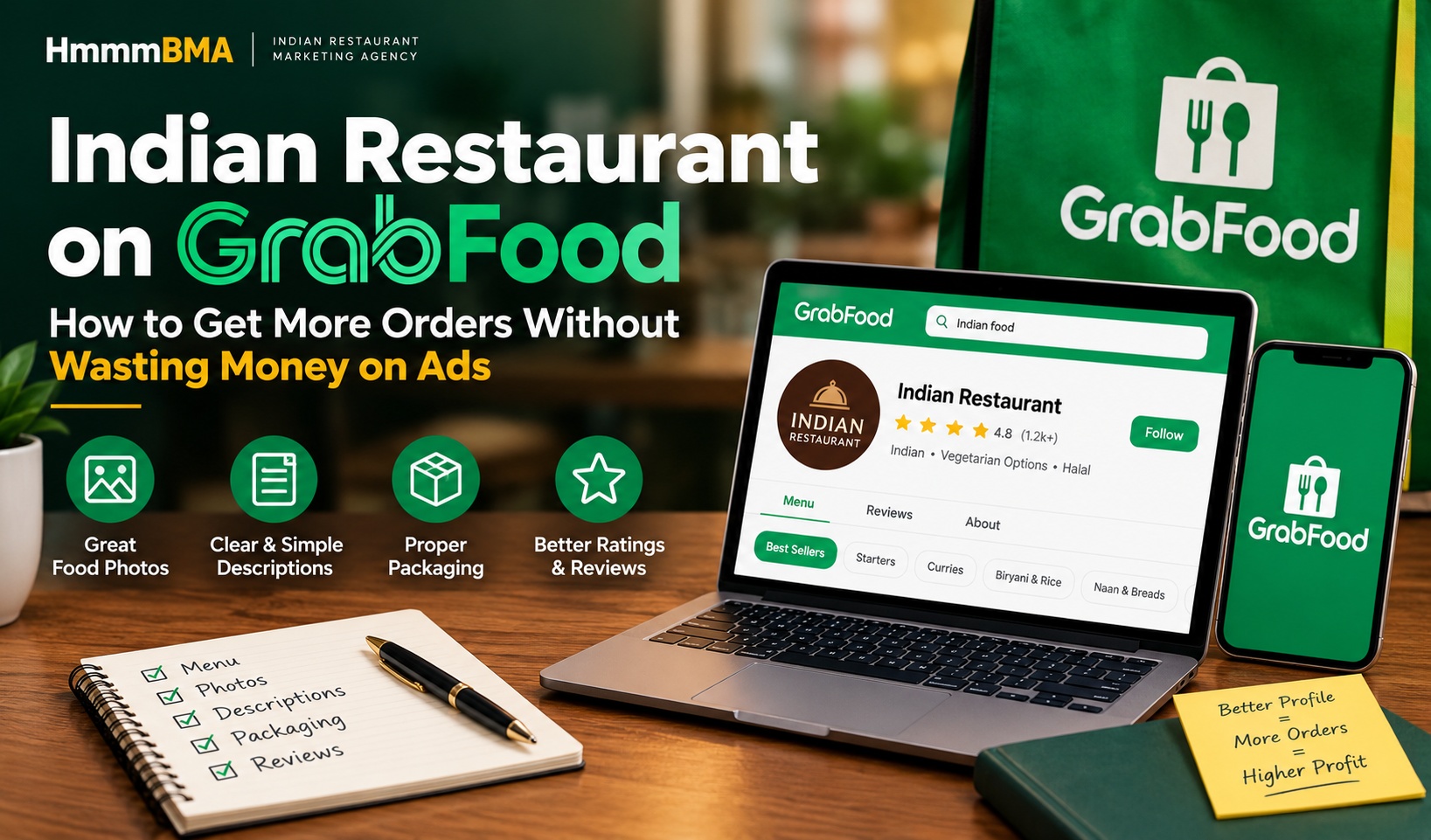
GrabFood for Indian Restaurants: How to Get More Orders Without Wasting Money on Ads
For an Indian restaurant, GrabFood can be an excellent source of delivery orders. But there is one mistake I see restaurants make again and again:
They believe that spending more money on GrabFood advertising will automatically make their delivery business successful.
Yes, advertising can bring visibility. Yes, it can generate orders.
But more orders do not always mean more profit.
From my experience working with Indian restaurants and their food-delivery profiles, I have learned something much simpler:
Before spending heavily on GrabFood ads, build a GrabFood profile that customers actually want to order from.
There is no secret trick.
Focus on your menu, real food photography, dish descriptions, packaging, ratings and customer reviews.
Do these things properly and consistently, and over time your restaurant can build a much stronger delivery presence without depending completely on paid advertising.
The Real Cost of Getting GrabFood Orders
Restaurant owners naturally want more orders.
When orders are slow, one of the first solutions they consider is advertising or promotions.
But before increasing your advertising budget, calculate what is actually left from every order.
GrabFood charges merchants a service fee or commission based on the agreement between Grab and the restaurant. The exact percentage can vary depending on the country, merchant agreement, program and other applicable charges.
Then there can be additional costs related to advertising, promotions, discounts, packaging, ingredients, taxes and restaurant operations.
In some restaurants I have worked with, the normal platform-related cost may already be around 20–25%. Once additional advertising, promotions, taxes or other costs are included, the effective cost of generating an order can sometimes move toward 30–35% or even higher.
These percentages should not be treated as a universal GrabFood rate. Every restaurant should check its own Grab agreement and actual monthly statements.
The important question is:
After all costs are deducted, how much money did the restaurant actually make?
A restaurant may receive hundreds of orders and still discover at the end of the month that its profit is very small.
That is why I don’t recommend blindly increasing GrabFood advertising just because you want more orders.
My Strategy: Fix the GrabFood Menu First
Before spending more on advertising, I focus on the restaurant’s GrabFood profile.
Imagine a customer opens GrabFood and finds your Indian restaurant.
They don’t smell your Butter Chicken.
They cannot touch your naan.
They cannot speak with your waiter.
They cannot experience your restaurant atmosphere.
They make their decision from what they see on their phone.
Your digital menu is effectively your salesperson.
So make it good.
1. Use Real, Beautiful Photos of Your Food
This is one of the most important things I recommend.
Use real photographs of the dishes you actually serve.
If you sell Butter Chicken, show your Butter Chicken.
If you sell Chicken Biryani, show the actual portion customers will receive.
If you sell Paneer Butter Masala, Garlic Naan, Samosa Chaat or Chicken Tikka Masala, photograph those real dishes.
The image should be clean, bright, sharp and appetising, but it should still look like the food the customer will receive.
Don’t create an unrealistic expectation.
A beautiful real photograph builds confidence.
This is particularly important for Indian food because many customers—especially local customers or international tourists who have never tried a particular Indian dish—may not know what the dish looks like.
The photo helps them make the decision.
For GrabFood menu items, square 1:1 images are a strong format to work with. Keep the dish clearly visible and remove distracting backgrounds, dirty surfaces, kitchen tools or unnecessary objects.
2. Don’t Stuff SEO Keywords Into Dish Descriptions
This is something I strongly believe restaurants should stop doing.
A GrabFood dish description is not a Google blog post.
You don’t need something like:
“Best Butter Chicken Indian Restaurant Near Me Authentic Indian Food Near Me Best Indian Curry Hanoi.”
That doesn’t help a hungry customer understand the dish.
Just describe the food.
For example:
Butter Chicken:
Tender chicken cooked in a smooth, creamy tomato and butter gravy with aromatic Indian spices.
That’s enough.
For Chicken Biryani:
Chicken Biryani:
Fragrant basmati rice slow-cooked with marinated chicken, aromatic spices and herbs, served with raita.
Simple. Clear. Useful.
Tell customers what they are buying.
A good description can mention the main ingredients, flavour, cooking style, portion information or what comes with the dish.
Your goal is not keyword stuffing.
Your goal is to help someone decide, “Yes, I want to eat this.”
3. Make Your Restaurant Profile Look Complete
Don’t only focus on individual dishes.
Look at the whole GrabFood storefront.
Your restaurant logo should be clear and recognisable.
Your cover image should look professional.
Categories should make sense.
Your best dishes should be easy to find.
Prices should be clear.
Unavailable items should be managed properly.
Customers should not have to work hard to understand your menu.
For an Indian restaurant, useful categories could include:
Best Sellers, Starters, Vegetarian Curries, Non-Vegetarian Curries, Biryani & Rice, Naan & Indian Breads, Indo-Chinese, Desserts and Beverages.
If you offer genuine vegan, Jain, pure vegetarian or halal options, make them easy for relevant customers to identify—but only make claims that are accurate for your restaurant.
4. Your Packaging Is Part of Your GrabFood Marketing
This is something restaurant owners sometimes underestimate.
Marketing doesn’t finish when the customer presses “Order.”
The next stage starts when the food leaves your kitchen.
Imagine someone sees a beautiful Chicken Biryani photo, orders it, waits 30 minutes and then receives leaking packaging, cold food or a messy container.
Your beautiful GrabFood profile cannot save that experience.
Good delivery packaging should protect the food and help it arrive as close as possible to how it left your kitchen.
For Indian food, this matters especially with curries, chutneys, raita, dal and other dishes that can leak if they are not packed correctly.
Check your containers.
Check the lids.
Separate items when necessary.
Keep breads properly wrapped.
Make sure sauces don’t leak.
Include the correct items before sealing the order.
Before trying to generate another 100 orders, make sure you can make your existing customers happy.
5. Reviews Are More Valuable Than They Look
For me, this is one of the biggest parts of long-term GrabFood growth.
Get more genuine customers.
Give them good food.
Pack it properly.
Deliver what your menu promised.
Then let customer satisfaction build your rating and review history naturally.
Think like a new customer.
Two Indian restaurants appear on their phone.
One has very few ratings and unclear photographs.
The other has attractive real food photos and a strong history of positive customer experiences.
Which profile creates more confidence?
Reviews reduce uncertainty.
That matters even more when the customer has never visited your physical restaurant.
Don’t buy fake reviews or try to manipulate ratings.
Focus on creating experiences that make genuine customers want to rate the restaurant positively.
6. Don’t Judge Success Only by Number of Orders
This is one of the biggest lessons from my experience.
Suppose advertising gives you 500 orders.
It looks fantastic.
But what did those 500 orders actually make?
Calculate:
Food cost + packaging + platform/service fees + advertising + promotions/discounts + taxes + other operating costs.
Then calculate what remains.
That number matters more than the order count.
An advertising dashboard can look exciting while your bank account tells a completely different story.
I would rather build a restaurant that receives sustainable, profitable orders than chase a large order number that produces almost no margin.
7. Use GrabFood Ads Strategically, Not Automatically
I am not saying restaurants should never advertise on GrabFood.
Grab provides advertising tools designed to increase merchant visibility, including placements in GrabFood search results and other areas of the app.
Advertising can be useful.
But advertising should amplify a good restaurant profile—not compensate for a bad one.
If your photographs are poor, menu descriptions are confusing, rating is weak, packaging causes complaints and your best dishes are difficult to find, why spend heavily sending more people to that profile?
Fix the foundation first.
Then test advertising carefully.
Start with a controlled budget.
Measure actual orders.
More importantly, measure actual profit.
If the numbers work, continue.
If you’re spending more but not making enough profit, rethink the campaign.
8. Give the Strategy Time
Don’t expect everything to change in seven days.
Building a strong delivery profile takes time.
Improve the photos.
Improve descriptions.
Organise the menu.
Improve packaging.
Maintain food quality.
Collect genuine customer feedback.
Watch which dishes customers order repeatedly.
Identify your real best sellers.
Keep improving.
Over the following months, the profile can become much stronger.
The goal is to reach a point where customers choose you because your restaurant already looks trustworthy—not only because an advertisement put you in front of them.
What If Your Indian Restaurant Is Outside the Tourist Area?
This strategy becomes even more important.
I have worked with restaurants that are not sitting in the middle of the main tourist area.
That doesn’t automatically mean they cannot generate delivery orders.
On a delivery application, customers first interact with your digital storefront.
A restaurant several kilometres away can still attract attention if the food looks excellent, the menu is clear, the pricing makes sense and previous customers have had good experiences.
Of course, delivery distance, availability, local demand and Grab’s own ranking and delivery systems can affect what customers see.
But being outside a tourist street doesn’t mean you should give up.
Build a profile worth ordering from.
Does This Work Only in Vietnam?
The principles are much broader.
Grab operates across multiple Southeast Asian markets, although its products, merchant programs, fees and availability differ by country and location.
Whether you operate an Indian restaurant in Vietnam, Thailand, Malaysia, Indonesia or another GrabFood market, the basic customer behaviour is similar:
People want to know what they are ordering.
They want food that looks good.
They want clear information.
They want reliable packaging.
And they want confidence that other customers have had a good experience.
The exact GrabFood tools, commissions, taxes, advertising options and merchant terms may differ, so always use your local Grab merchant agreement and current restaurant data when making financial decisions.
A Simple GrabFood Checklist for Indian Restaurants
Before increasing your GrabFood advertising budget, ask yourself:
– Do all of my important dishes have good real photographs?
– Does the delivered food actually look like the photographs?
– Are my descriptions short, natural and useful?
– Is my menu divided into simple categories?
– Are my restaurant logo and cover image professional?
– Are my best-selling dishes easy to discover?
– Is my packaging strong enough for delivery?
– Are customers consistently satisfied with food quality?
– Am I receiving genuine ratings and reviews?
– Do I know my real profit after Grab fees, advertising, promotions, food costs and packaging?
– Am I measuring profit instead of only celebrating order volume?
If several answers are “no,” I would work on those areas before putting significantly more money into advertising.
The HmmmBMA Approach to GrabFood Marketing
At HmmmBMA, our approach to food-delivery marketing for Indian restaurants is straightforward.
We don’t believe every problem should be solved by spending more money on advertising.
Sometimes the biggest improvement comes from fixing what the customer already sees.
A better Butter Chicken photograph.
A clearer Biryani description.
A properly organised menu.
Better packaging.
More consistent food.
A stronger rating built from genuine customer experiences.
These may look like small changes individually.
Together, they can completely change how customers see your restaurant on a delivery application.
Final Thoughts: Build Trust Before You Buy Visibility
If there is one thing I want Indian restaurant owners to remember from this article, it is this:
Don’t pay to send more customers to a GrabFood profile that isn’t ready to convert them.
Build the foundation first.
Use real food photography.
Write normal, helpful dish descriptions.
Keep the menu clean.
Improve your packaging.
Deliver consistent food.
Earn genuine customer reviews.
Understand exactly how much profit remains from each order.
Then use advertising when the numbers make sense.
There is no magic trick.
In my experience, the restaurants that build these basics properly have a much better chance of growing their delivery business sustainably than restaurants that simply keep increasing advertising spend.
More orders look good.
Profitable, repeatable orders are better.
About HmmmBMA
HmmmBMA is an Indian restaurant marketing agency helping Indian restaurants improve their online presence, food-delivery menus, restaurant photography, Google Business Profile, reviews, social media, websites, SEO and digital advertising.
Our focus is simple: practical restaurant marketing built around what customers actually see, search, order and experience.
