


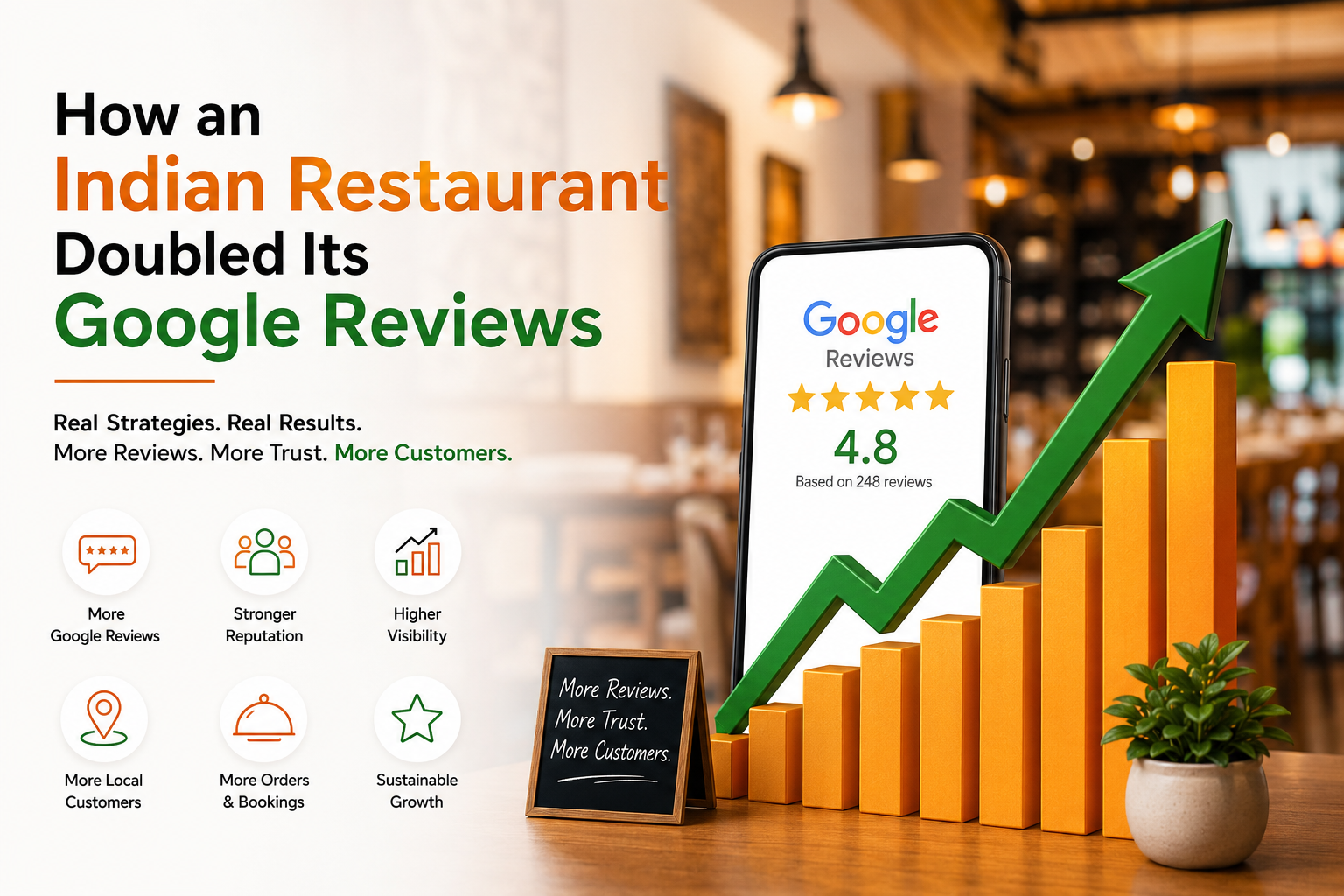
How an Indian Restaurant Doubled Its Google Reviews
Running a good Indian restaurant is not always enough to succeed online.
A restaurant may serve excellent butter chicken, biryani, dosa, paneer dishes or freshly baked naan. Customers may leave happy and even tell the team they loved the food.
But there is one common problem:
Happy customers often leave the restaurant without leaving a Google review.
This was exactly the challenge for one Indian restaurant we worked with.
The restaurant already had satisfied customers and a good dining experience. The problem was not necessarily the food or service. The problem was that there was no consistent system for turning customer satisfaction into genuine Google reviews.
Instead of chasing complicated marketing tricks, the restaurant focused on improving one simple part of its customer journey.
The result?
The restaurant doubled its Google reviews.
Here is what changed and what other Indian restaurant owners can learn from it.
The Problem: Customers Were Happy, But Reviews Were Growing Slowly
Like many Indian restaurants, the team believed that good food would naturally generate reviews.
Sometimes it did.
A customer would enjoy the meal, open Google Maps and leave feedback without being asked. But most customers simply paid their bill and left.
This is normal.
A customer may say:
“The biryani was excellent.”
“This is the best Indian food we have had on our trip.”
“The staff were very friendly.”
“We will definitely come again.”
Those are wonderful comments, but unless some of those experiences become online reviews, future customers searching on Google may never see them.
The restaurant therefore had two different realities:
Offline: Many happy customers.
Online: Not enough recent reviews showing those experiences.
The goal was not to pressure customers or generate artificial reviews.
The goal was simply to make it easier for genuine customers who wanted to share their experience.
Step 1: The Team Started Asking at the Right Moment
One of the biggest changes was surprisingly simple.
The restaurant started asking happy customers for feedback.
But timing mattered.
Staff did not immediately ask for a Google review when customers sat down or while they were eating.
Instead, they looked for natural moments near the end of the experience.
For example, when a customer finished dinner and said:
“Everything was delicious.”
That was an opportunity.
The staff member could naturally respond:
“Thank you! We’re really happy you enjoyed it. If you have a moment, we’d appreciate it if you shared your experience on Google.”
Simple.
Friendly.
No pressure.
The important lesson was that the restaurant did not need to ask every customer mechanically.
The conversation needed to feel human.
Step 2: Leaving a Review Became Easier
Another problem was friction.
Imagine telling a tourist:
“Please find our restaurant on Google and leave us a review.”
The customer may genuinely intend to do it.
But then they need to open Google, search for the restaurant, identify the correct listing and find the review section.
Many people will simply forget.
The restaurant made the process easier by providing convenient access to its Google review page, such as through a QR code or direct review link.
A customer could scan, open the correct Google Business Profile and leave feedback.
Reducing unnecessary steps made a significant difference.
Step 3: Staff Understood Why Reviews Matter
Getting more reviews cannot depend only on the restaurant owner.
Front-of-house employees interact with customers every day.
So the team needed to understand why Google reviews mattered.
Reviews are not simply about collecting stars.
They can help future customers understand:
– What the food is really like
– Which dishes guests recommend
– Whether vegetarian or vegan choices are available
– What the service experience is like
– Whether families or groups enjoy the restaurant
– Whether international tourists feel comfortable dining there
– What makes the restaurant different from nearby alternatives
Once staff understood this, asking for genuine feedback became part of good customer service rather than an awkward marketing task.
Step 4: The Restaurant Stopped Treating Every Review the Same
A short five-star review is valuable.
But detailed reviews can provide much more information to future customers.
Compare these two reviews:
“Good restaurant.”
and:
“We visited this Indian restaurant for dinner and loved the chicken biryani, butter chicken and garlic naan. The staff were friendly and helped us choose the spice level.”
Both are positive.
But the second review tells a potential customer much more about the restaurant.
The restaurant never told customers exactly what to write.
Instead, customers were encouraged to share their genuine experience.
Naturally, people began mentioning dishes, service, atmosphere and other details that mattered to them.
This created a much richer picture of the restaurant online.
Step 5: Reviews Were Collected Consistently
One of the biggest lessons from this success story was:
Consistency beats occasional review campaigns.
Many restaurants suddenly focus on reviews for a few days.
They collect some reviews and then stop.
A better approach is to make genuine review generation part of everyday restaurant operations.
Five reviews today and nothing for the next three months is very different from receiving fresh customer feedback regularly.
For potential customers, recent reviews can also help answer an important question:
“Is this restaurant still good today?”
That is particularly important in tourist destinations where customers may know nothing about the restaurant before searching online.
Step 6: The Restaurant Replied to Its Reviews
Getting the review was not considered the end of the process.
The restaurant also started responding.
Instead of using exactly the same generic reply every time, responses were connected to what the customer actually wrote.
If someone mentioned biryani, the reply could acknowledge the biryani.
If someone praised the staff, the restaurant could thank them for recognizing the service.
If a tourist mentioned visiting during a holiday, the response could wish them a pleasant trip.
This made the Google Business Profile feel active and cared for.
It also meant that review replies were useful not only for the original reviewer but also for future customers reading the conversation.
Step 7: Negative Feedback Was Not Ignored
A strong review strategy does not mean expecting only positive feedback.
Restaurants occasionally receive criticism.
Food may arrive late.
A dish may be too spicy.
A customer may dislike a particular preparation.
Service may not meet expectations during a busy period.
Instead of fighting with customers publicly, the restaurant treated legitimate negative feedback as information.
The team looked for recurring problems and considered whether something needed to change operationally.
Professional responses also showed future customers that the restaurant took feedback seriously.
What Happened?
With a consistent system in place, review growth accelerated.
The restaurant was not suddenly serving completely different food.
It was not relying on fake reviews.
It was not offering incentives in exchange for positive ratings.
It simply became much better at giving genuine customers an easy opportunity to share their experiences.
Over time, the restaurant doubled its Google reviews.
But the number itself was only part of the success.
The Google Business Profile now contained more recent customer experiences, more dish mentions, more useful information and more social proof for people discovering the restaurant for the first time.
Why Google Reviews Are Especially Important for Indian Restaurants
Indian restaurants often serve several very different customer groups.
A restaurant may welcome:
– Indian residents
– International tourists
– Business travellers
– Local customers
– Vegetarians
– Vegans
– Jain diners
– Halal-conscious customers
– Families
– Groups
Each group may search differently.
Someone might search Google for:
“Indian restaurant near me”
“best Indian food near me”
“vegetarian Indian restaurant”
“halal Indian restaurant”
“Indian restaurant open now”
“best biryani near me”
Google reviews can help potential customers understand whether a restaurant fits what they are looking for.
Real customer experiences therefore become an important part of the restaurant’s online reputation and local visibility.
Reviews Are Also Becoming Important Beyond Google Search
Restaurant discovery is changing.
Customers are increasingly asking AI assistants questions such as:
“Where can I find a good Indian restaurant near my hotel?”
“Which Indian restaurant nearby has good vegetarian food?”
“Where can I get good biryani tonight?”
Google Maps remains extremely important, but restaurants should also think about how clearly their overall online presence describes their business.
Reviews, menus, websites, business information and other reliable online references collectively help build a clearer digital identity.
That is why restaurant marketing today should not focus on one platform alone.
What Other Indian Restaurants Can Learn From This Success Story
The biggest lesson is not simply:
“Get more reviews.”
The real lesson is to create a repeatable system.
A restaurant should:
– Deliver an experience worth reviewing.
– Identify natural moments to ask for genuine feedback.
– Make the review process easy.
– Train staff to ask politely without pressure.
– Encourage customers to describe their real experience in their own words.
– Respond professionally to reviews.
– Learn from negative feedback.
– Continue consistently instead of running occasional review campaigns.
None of these steps requires a huge advertising budget.
But together they can make a major difference over time.
What Restaurants Should NOT Do
There is an important line between review marketing and review manipulation.
Restaurants should avoid:
– Buying Google reviews
– Creating fake customer accounts
– Asking employees to pretend to be customers
– Offering rewards specifically for positive reviews
– Telling customers exactly what rating to give
– Posting large numbers of unnatural reviews at once
The objective should always be to generate more genuine customer feedback, not manufacture popularity.
A smaller number of authentic reviews is far more valuable to a restaurant’s long-term reputation than hundreds of questionable ones.
Frequently Asked Questions
How can an Indian restaurant get more Google reviews?
Start by delivering a strong customer experience, then politely invite genuine customers to share feedback. Make the process easy with direct access to the restaurant’s Google review page and train staff to ask at natural moments.
Should restaurant staff ask every customer for a five-star review?
No. Restaurants should ask for honest feedback rather than demanding a particular rating. Customers should decide what rating and comments reflect their experience.
Should restaurants reply to Google reviews?
Yes. Thoughtful responses show customers and future readers that the business values feedback. Replies should be natural and connected to the customer’s actual experience whenever possible.
Can Google reviews help an Indian restaurant attract tourists?
They can be particularly influential for tourists who do not already know the local restaurant market. Reviews can help travellers compare restaurants, discover recommended dishes and understand other customers’ experiences before deciding where to eat.
Are Google reviews enough for restaurant marketing?
No. Reviews are one important part of a broader strategy that can include Google Business Profile optimisation, Local SEO, website content, menu optimisation, social media, delivery platforms and visibility across emerging AI-powered discovery experiences.
Final Thoughts
Doubling Google reviews did not happen because of one secret marketing trick.
It happened because the restaurant turned something it already had — happy customers — into a consistent source of genuine online feedback.
For Indian restaurants, that distinction matters.
You do not need to pressure customers.
You do not need fake reviews.
And you do not need to chase numbers at any cost.
Build a great customer experience, make it easy for people to share that experience, respond professionally and repeat the process consistently.
Your Google reviews should become a reflection of what is already happening inside your restaurant.
About HmmmBMA
HmmmBMA is an Indian Restaurant Marketing Agency focused exclusively on helping Indian restaurants outside India strengthen their digital presence.
Our approach brings together Google Business Profile optimisation, Google Maps and Local SEO, review strategy, restaurant websites, delivery-platform optimisation, social media and AI-search visibility.
Because Indian restaurants have unique customers, menus and marketing challenges, we believe their digital marketing deserves a specialised approach.
HmmmBMA — Indian Restaurant Marketing Specialists
