


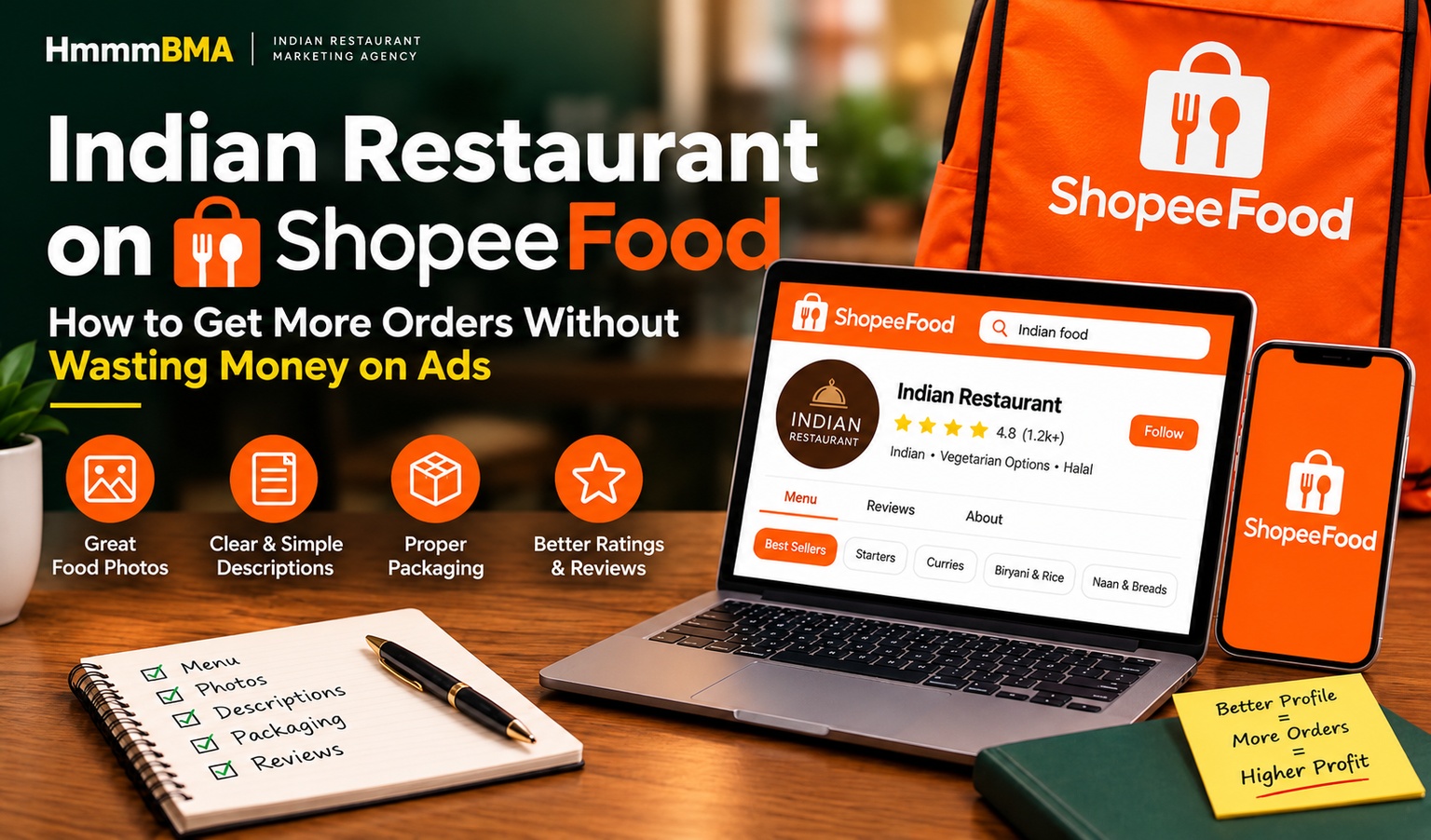
ShopeeFood for Indian Restaurants: How to Get More Orders Without Wasting Money on Ads
For an Indian restaurant, ShopeeFood can be a valuable source of online food delivery orders, especially in Southeast Asia.
But there is one mistake I see restaurant owners make again and again.
They believe spending more money on ShopeeFood advertising, discounts and promotions will automatically bring more customers and increase profits.
Yes, advertising can improve visibility.
Yes, discounts can encourage customers to order.
But more orders do not always mean more profit.
From my experience working with Indian restaurants and managing food delivery profiles, I have learned something important:
Before spending heavily on ShopeeFood advertising, build a restaurant profile that customers actually want to order from.
Your food photography, menu categories, dish descriptions, pricing, packaging, ratings and customer experience all matter.
A well-managed ShopeeFood profile can help your restaurant attract customers, build trust and encourage repeat orders without depending entirely on paid promotions.
There is no magic formula.
The goal is simple: make your restaurant easier to discover, easier to understand and more attractive to order from.
What Is ShopeeFood and Why Does It Matter for Indian Restaurants?
ShopeeFood is an online food ordering and delivery service operating in several Southeast Asian countries.
It connects customers with restaurants and delivery partners, allowing people to order meals directly from their smartphones.
For Indian restaurants, this creates an opportunity to reach customers beyond traditional dine-in traffic.
Think about an Indian restaurant located outside a busy tourist area.
The restaurant may serve excellent Butter Chicken, Chicken Biryani, Paneer Tikka, Masala Dosa and Garlic Naan.
But if few people walk past the restaurant, how will new customers discover it?
Food delivery platforms can help solve part of that problem.
Customers may discover your restaurant while browsing available cuisines, comparing menus or looking for a particular dish.
However, being listed on ShopeeFood does not guarantee orders.
Your restaurant still needs to convince customers to choose your food over competing options.
That is where proper ShopeeFood marketing becomes important.
In Which Countries Is ShopeeFood Available?
As of October 2026, ShopeeFood operates in five Southeast Asian countries:
Vietnam – Including Hanoi, Ho Chi Minh City, Da Nang and other supported cities.
Indonesia – Including Jakarta, Surabaya and other covered locations.
Malaysia – Including Kuala Lumpur, Penang, Johor Bahru and other supported areas.
Thailand – Including Bangkok and other participating provinces.
Philippines – ShopeeFood began rolling out in selected Metro Manila locations in September 2026.
The service is not available in every city or neighbourhood within these countries.
Restaurant owners should check current merchant eligibility, delivery coverage and local ShopeeFood requirements before planning their strategy.
Also, ShopeeFood is not the same as the general Shopee shopping marketplace. Shopee may operate in a country without offering its restaurant food delivery service there.
For Indian restaurant owners in these five markets, ShopeeFood may provide another channel for reaching local residents, office workers, families, international visitors and customers who enjoy Indian cuisine.
1. Start With Professional, Real Food Photography
When someone visits your Indian restaurant on ShopeeFood, they cannot smell your curry or taste your biryani.
They cannot experience your restaurant atmosphere.
They make their decision using the information displayed on their phone.
That is why food photography is one of the first areas I examine when auditing a ShopeeFood restaurant profile.
Imagine two Indian restaurants selling Chicken Biryani.
The first uses a dark, blurry photograph taken in the kitchen.
The second displays a bright, clear photograph showing fragrant basmati rice, tender chicken and the actual portion customers receive.
Which restaurant is more likely to attract attention?
Good photography helps customers understand the food and feel confident ordering it.
For Indian restaurants, I recommend photographing important dishes such as:
– Butter Chicken
– Chicken Biryani
– Mutton Biryani
– Paneer Butter Masala
– Chicken Tikka Masala
– Tandoori Chicken
– Garlic Naan
– Masala Dosa
– Samosa Chaat
– Mango Lassi
Use photographs of the actual food your restaurant prepares.
Avoid misleading images that look completely different from what customers receive.
For menu preparation, a clean square 1:1 composition is a useful starting point, although restaurants should always follow the current image specifications of their local ShopeeFood merchant system.
Remove unnecessary objects, distracting backgrounds and untidy surfaces.
Keep the food clearly visible.
Your goal is not simply to make the image beautiful.
Your goal is to help customers decide what to order.
2. Write Clear ShopeeFood Dish Descriptions
Many Indian restaurant menus contain dish names that local customers may not understand.
For example:
What is Dal Makhani?
What is Paneer Butter Masala?
What is Rogan Josh?
What is the difference between Chicken Tikka and Chicken Tikka Masala?
An Indian customer may already know these dishes.
But a Vietnamese, Thai, Malaysian, Indonesian or Filipino customer may need a short explanation.
That is why dish descriptions are important.
I recommend simple, natural descriptions that explain the ingredients, cooking style and flavour.
Butter Chicken
Tender chicken cooked in a rich, creamy tomato and butter gravy with aromatic Indian spices.
Chicken Biryani
Fragrant basmati rice cooked with marinated chicken, traditional Indian spices and herbs.
Palak Paneer
Soft cottage cheese cubes simmered in a smooth spinach gravy with mild Indian spices.
Masala Dosa
Crispy South Indian rice and lentil crepe filled with spiced potatoes, served with chutneys and sambar.
These descriptions are short, understandable and useful.
Avoid filling your menu with repetitive search phrases such as “best Indian food near me” or “number one Indian restaurant.”
A ShopeeFood menu should help hungry customers understand what they are buying.
It should not read like an advertisement.
3. Organize Your Indian Restaurant Menu Properly
Another common problem I notice is poor menu organization.
Some Indian restaurants have 100 or even 200 dishes.
But everything is mixed together.
Customers scroll through long lists of curries, naan, rice, snacks and drinks without clear categories.
That creates unnecessary confusion.
I recommend organizing the ShopeeFood menu into practical sections.
For example:
– Best Sellers
– Indian Starters
– Vegetarian Curries
– Chicken & Meat Curries
– Biryani & Rice
– South Indian Specialties
– Naan & Indian Breads
– Indo-Chinese Dishes
– Indian Street Food
– Desserts & Beverages
The exact categories should depend on your restaurant’s menu and the features supported by ShopeeFood.
Place your strongest dishes where customers can find them easily.
If Chicken Biryani, Butter Chicken and Garlic Naan are your most popular products, make them easy to discover.
Don’t force customers to scroll through 50 items to find your best-selling dish.
A well-organized menu can make the ordering experience faster and easier.
4. Local Language Matters on ShopeeFood
This is particularly important for Indian restaurants operating in Southeast Asia.
Many Indian restaurant owners prepare their menus only in English.
English may work well for Indian expatriates and international visitors.
But your restaurant may also depend heavily on local customers.
In Vietnam, Vietnamese descriptions can help local customers understand unfamiliar dishes.
In Thailand, Thai-language explanations can make the menu more accessible.
In Indonesia, Bahasa Indonesia is important.
In Malaysia, Bahasa Malaysia and English may both be useful.
In the Philippines, English is widely understood, while Filipino descriptions may be helpful for some audiences.
The best language strategy depends on your location and customers.
Where ShopeeFood supports multiple languages, use those features correctly.
Where it does not, keep descriptions clear and follow the platform’s current formatting rules.
For Indian food, translation should explain the actual dish rather than simply translate the name word for word.
For example, Paneer Tikka is more understandable when the description explains that it contains Indian cottage cheese marinated in spices and grilled.
Good localization helps customers understand the menu.
It does not guarantee higher search rankings, but it can remove confusion from the buying decision.
5. Create Attractive Indian Food Combos
Combos can be useful for increasing average order value when the pricing makes financial sense.
Indian food naturally offers several combinations.
For example:
Butter Chicken Meal
Butter Chicken + Garlic Naan + Jeera Rice
Vegetarian Indian Meal
Paneer Butter Masala + Butter Naan + Dal Tadka
Biryani Meal
Chicken Biryani + Raita + Beverage
South Indian Breakfast Combo
Masala Dosa + Idli + Sambar + Chutney
Family Indian Dinner
Chicken Curry + Paneer Curry + Basmati Rice + Naan
The important thing is to create combinations that customers genuinely want.
Do not create discounts so large that your restaurant loses money.
Calculate the ingredient cost, packaging, platform fees and promotion expense for every combo.
A successful combo should offer convenience and value to customers while maintaining a reasonable contribution margin for your restaurant.
6. Packaging Is Part of Your ShopeeFood Marketing
Many restaurant owners think marketing ends when a customer places an order.
I disagree.
The delivery experience is part of your restaurant’s marketing.
Imagine someone orders Butter Chicken and Garlic Naan after seeing attractive photographs.
The order arrives with leaking curry, soggy naan and spilled chutney.
Will that customer want to order again?
Probably not.
Good packaging protects the food and reinforces customer confidence.
For Indian restaurants, packaging is particularly important because many dishes contain sauces, gravies and accompaniments.
I recommend checking:
– Leak-resistant containers for curries and dal
– Properly sealed packaging for chutneys and raita
– Suitable containers for biryani and rice
– Separate packaging for naan and other breads
– Appropriate temperature control and food safety practices
– Clear identification of different dishes
– Correct portions and order accuracy
Premium packaging can also support your restaurant’s brand positioning.
However, expensive packaging is not automatically better.
Choose packaging that protects the food, fits your pricing and makes financial sense.
A good delivery experience encourages customers to trust your restaurant again.
7. Build Genuine Customer Ratings and Reviews
Customer reviews are another important part of food delivery marketing.
Imagine a new customer finds two Indian restaurants on ShopeeFood.
One restaurant has unclear photographs, inconsistent customer feedback and limited information.
The other has attractive food images, clear descriptions and a strong history of genuine positive customer experiences.
The second restaurant may inspire more confidence.
That does not mean ratings are the only factor influencing customer decisions.
Price, delivery availability, promotions, distance and personal preferences also matter.
But customer trust is valuable.
To build a stronger reputation, focus on the basics.
Prepare food consistently.
Send the correct items.
Maintain portion quality.
Use reliable packaging.
Resolve customer problems professionally.
Where the merchant system allows it, respond politely to genuine feedback.
Never buy fake reviews or offer unauthorized incentives in exchange for positive ratings.
A strong reputation should reflect real customer satisfaction.
8. Don’t Depend Completely on ShopeeFood Discounts
ShopeeFood customers may encounter vouchers, free-delivery offers, promotional campaigns and other incentives.
These can encourage purchases.
But restaurant owners need to understand who pays for each promotion.
Some promotions may be funded by the platform.
Others may require merchant contributions.
Terms vary by country and campaign.
Before joining a promotion, ask:
How much is the restaurant contributing?
Will the promotion increase profitable orders?
Are customers ordering only because of a large discount?
Will they return at the normal menu price?
A discount that attracts 100 orders but leaves almost no margin may not be a good business decision.
I prefer promotions that are controlled, measurable and financially sustainable.
The objective should be long-term restaurant growth, not simply a temporary increase in order numbers.
9. Use ShopeeFood Advertising Strategically
I am not against advertising.
Paid visibility can be useful when the right advertising products are available in your local ShopeeFood merchant system.
But advertising should support a good restaurant profile.
It should not be used to hide fundamental problems.
Before launching a campaign, check whether:
– Your important dishes have attractive real photographs.
– Your menu descriptions are accurate.
– Your prices and portions are competitive.
– Your best sellers are easy to find.
– Your packaging is reliable.
– Your restaurant can handle additional orders.
– Your contribution margins are positive.
If these basics are weak, attracting more visitors may simply expose more customers to a disappointing experience.
When you decide to advertise, start with a manageable budget.
Track campaign spending, orders, average order value and actual contribution after costs.
Remember that advertising options, reporting features and campaign formats can differ between ShopeeFood markets.
Use the tools and data available in your local merchant account.
If advertising generates profitable orders, you can consider expanding.
If it creates more revenue but little profit, adjust the strategy.
10. Understand Your Local Indian Food Customers
Not every Indian restaurant serves the same audience.
An Indian restaurant in Hanoi may attract Vietnamese customers, Indian expatriates, office workers and international tourists.
A restaurant in Bangkok may serve Thai residents, Indian families and visitors from different countries.
In Kuala Lumpur, halal food positioning may be particularly relevant to customers seeking suitable dining options.
In Jakarta, local preferences, pricing and food familiarity can influence ordering decisions.
In Metro Manila, restaurants entering ShopeeFood’s newer delivery market need to understand the customers and competition within their actual service area.
Your marketing should reflect your restaurant’s location.
For example, if your restaurant serves authentic halal Indian food, communicate that accurately.
If your kitchen is entirely vegetarian, make that clear.
If you offer Jain meals, vegan dishes or South Indian specialties, explain the options properly.
Never describe a dish as vegan if it contains ghee, butter, milk, cream or paneer.
Never make halal or other dietary claims that your restaurant cannot substantiate.
Customers need accurate information.
11. Can Indian Restaurants Outside Tourist Areas Succeed on ShopeeFood?
Yes, they can attract delivery orders, provided there is sufficient demand and delivery coverage in their area.
I often see restaurant owners worrying because their location is not near a famous tourist street.
But food delivery works differently from traditional walk-in business.
Customers browse restaurants through an application.
They compare food photographs, menus, prices, ratings, delivery availability and promotions.
A restaurant located several kilometres away may still be an attractive option.
Of course, the platform’s delivery coverage, estimated delivery time, ranking systems and local competition can affect visibility.
Being outside a tourist area does not automatically guarantee success.
But it also does not mean your restaurant cannot build a strong delivery business.
Focus on serving your reachable local customers.
Study their ordering habits.
Offer dishes they enjoy.
Make your ShopeeFood profile worth choosing.
12. Measure Profit and Repeat Orders, Not Just Sales
This is one of the most important lessons I share with Indian restaurant owners.
Suppose your restaurant receives 500 ShopeeFood orders this month.
That sounds exciting.
But what happened financially?
How much revenue did those orders generate?
How much did you spend on ingredients, packaging, commissions, discounts and advertising?
How many orders were cancelled or refunded?
How much money remained after all expenses?
Order count alone cannot answer these questions.
Track your business using practical indicators such as:
– Total completed orders
– Gross sales
– Average order value
– Food and packaging costs
– Platform fees
– Merchant-funded discounts
– Advertising expenditure
– Contribution margin
– Customer complaints and refunds
– Repeat customer behaviour, where measurable
Not all ShopeeFood merchant dashboards provide the same customer-level reporting.
Use the data available to you, along with your own restaurant accounting records.
A sustainable delivery business should generate worthwhile margins and encourage customers to return.
13. Give Your ShopeeFood Strategy Time
One mistake restaurant owners make is expecting immediate results.
They improve a few menu photographs and expect orders to double the following week.
That is not how sustainable restaurant marketing works.
Menu optimization is an ongoing process.
Start by improving your most important dishes.
Then review your descriptions.
Organize your categories.
Improve your packaging.
Monitor customer feedback.
Study which dishes perform well.
Adjust pricing and combinations when necessary.
Test promotions carefully.
Over time, these improvements can strengthen the customer experience and the effectiveness of your ShopeeFood storefront.
There is no guaranteed timeline or guaranteed order increase.
But consistently improving the basics gives your restaurant a stronger foundation.
ShopeeFood vs GrabFood: Should Indian Restaurants Use Both?
This is a common question.
If ShopeeFood and GrabFood both operate in your restaurant’s location, listing on both may help you reach different groups of customers.
However, running multiple delivery platforms requires proper management.
You need to maintain accurate menus, prices, opening hours and item availability.
Your kitchen must be able to handle incoming orders without delays.
Your team should understand each platform’s procedures.
Most importantly, you need to calculate profitability separately.
A dish that is profitable on one platform may have a different margin on another because of fees, promotions or other costs.
Do not assume that the same advertising and pricing strategy will work everywhere.
If you also use GrabFood, read our related guide:
GrabFood for Indian Restaurants: How to Get More Orders Without Wasting Money on Ads
Both platforms can be valuable, but each restaurant should make decisions based on its local market and actual financial results.
How HmmmBMA Helps Indian Restaurants Improve ShopeeFood Performance
At HmmmBMA, we focus specifically on marketing for Indian restaurants.
We understand that promoting Indian food requires more than uploading a menu and running advertisements.
Different customers have different expectations.
Some customers already know Indian cuisine.
Others may be ordering Indian food for the first time.
Some are looking for vegetarian dishes.
Others want halal meals, authentic biryani, North Indian curries, South Indian food or Indian street food.
Our approach focuses on improving the complete digital customer experience.
Depending on the restaurant’s needs and available platform features, our work can include:
ShopeeFood Profile Audit
Reviewing restaurant presentation, menu structure, food photographs, descriptions and areas for improvement.
Food Menu Optimization
Organizing categories, improving dish information and making important products easier to discover.
Professional Food Image Preparation
Preparing clean, attractive and realistic menu photographs that represent the restaurant’s actual dishes.
Multilingual Menu Content
Helping restaurants communicate dishes clearly to relevant local and international customers.
Food Delivery Marketing Strategy
Reviewing pricing, meal combinations, promotions and opportunities to improve order profitability.
Reputation and Customer Experience
Helping restaurants strengthen the consistency of their digital presentation and customer communication.
Restaurant Digital Marketing
Supporting restaurants through Google Business Profile, local SEO, websites, social media, online advertising and other relevant marketing channels.
Our objective is not simply to make a restaurant spend more on advertising.
We want Indian restaurants to build a stronger digital presence and make better marketing decisions.
Frequently Asked Questions About ShopeeFood for Indian Restaurants
Is ShopeeFood good for Indian restaurants?
ShopeeFood can be a useful sales channel for Indian restaurants in supported locations. Results depend on customer demand, delivery coverage, menu quality, pricing, competition and restaurant operations.
How can I increase ShopeeFood orders without advertising?
Start by improving real food photographs, menu descriptions, categories, best-selling dishes, packaging and customer satisfaction. These improvements can make your storefront more appealing, although increased orders are not guaranteed.
Does ShopeeFood operate in Vietnam?
Yes. ShopeeFood operates in Hanoi, Ho Chi Minh City, Da Nang and numerous other supported locations across Vietnam.
Is ShopeeFood available in Thailand, Malaysia and Indonesia?
Yes. ShopeeFood operates in all three countries, although service coverage and merchant features vary by location.
Is ShopeeFood available in the Philippines?
Yes. ShopeeFood began a limited rollout in selected Metro Manila locations in September 2026. Restaurant owners should confirm current availability in their area.
Does ShopeeFood operate in Singapore?
As of October 2026, Singapore is not among ShopeeFood’s five confirmed food delivery markets. The general Shopee marketplace is available in Singapore, but that is a separate service.
How much commission does ShopeeFood charge restaurants?
There is no single commission percentage that should be assumed for every restaurant across all countries. Fees depend on local merchant agreements, programs and applicable charges. Check your current ShopeeFood merchant contract.
Should Indian restaurants advertise on ShopeeFood?
Advertising may be useful when the restaurant has an attractive menu, reliable operations and sufficient profit margins. Start with controlled spending and measure actual financial results.
Can a pure vegetarian or halal Indian restaurant succeed on ShopeeFood?
Such restaurants can attract customers seeking those food options where local demand exists. Accurate menu information, clear dietary positioning and consistent food quality are important.
Should I use both GrabFood and ShopeeFood?
Using both platforms may increase your potential reach where both are available. However, you should manage each platform carefully and evaluate fees, operational workload and profitability separately.
Final Thoughts: Build a Better ShopeeFood Restaurant Before Spending More on Ads
If there is one thing I want Indian restaurant owners to remember, it is this:
Don’t spend heavily bringing customers to a ShopeeFood profile that is not ready to convert them into satisfied customers.
Start with the basics.
Use real, beautiful food photographs.
Write simple and accurate descriptions.
Organize your menu.
Make your best-selling dishes easy to find.
Offer sensible combinations.
Improve packaging.
Maintain food quality.
Build trust through genuine customer experiences.
Understand your costs.
Then consider advertising when the numbers make sense.
A successful food delivery business is not built only on promotions.
It is built on food quality, customer confidence, consistent operations and sustainable profitability.
More orders are good.
Profitable orders and returning customers are even better.
About HmmmBMA
HmmmBMA is an Indian Restaurant Marketing Agency helping Indian restaurants strengthen their digital presence and reach more customers.
We work with restaurant marketing, food delivery menu optimization, food photography, Google Business Profile, local SEO, reputation management, social media, websites and digital advertising.
Our focus is practical marketing designed around how customers discover, compare, order and experience Indian food.
Want to improve your Indian restaurant’s ShopeeFood performance?
Visit HmmmBMA to explore our Indian restaurant marketing services and discuss opportunities to improve your food delivery presence.
